

Caleb Banks is a Swing for the Fences
The Vikings produced one of the biggest surprises of the NFL draft. By selecting Caleb Banks, they may have drafted the highest-ceiling rookie in the NFL. Or, they may have crashed their defense.


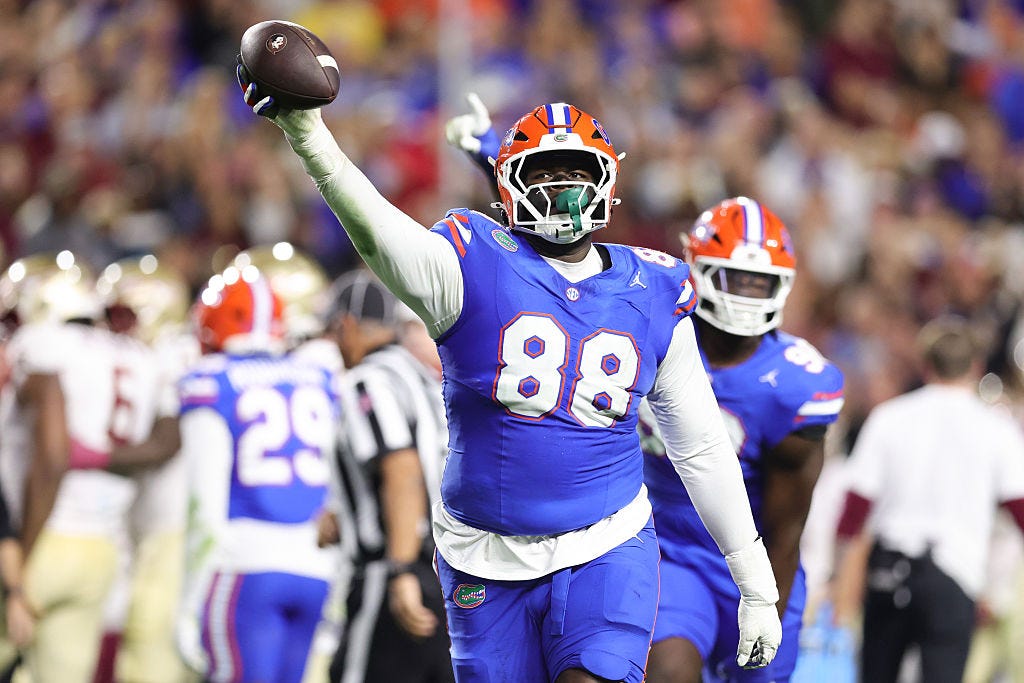
With the 18th overall pick in the 2026 NFL Draft, the Minnesota Vikings selected Caleb Banks, DT out of the University of Florida. In a draft full of surprises, Banks was nevertheless one of the most surprising picks of the first round, ranked 37th by the consensus board and taken in front of two other interior defenders ranked ahead of him in Peter Woods and Kayden McDonald.
In drafting a player who was rated much lower by consensus, it makes sense to question whether the Vikings should have tried to trade back and draft Banks later to at least recoup some value if the team was going to reach. It’s reasonable to infer that the Philadelphia Eagles would have been willing to offer the trade they made with the Dallas Cowboys at 20 to go up to 18 with the Vikings. To move up, the Eagles traded 23, along with two 4th-round picks — 114 and 137 — while acquiring a 2027 7th-round pick on the way back.
Pasting that exact trade would have the Vikings losing by about a fringe 4th/5th round pick on the Jimmy Johnson chart — coincidentally exactly pick 137 — but exactly equal on the Rich Hill chart and as significant winners on the analytics-based charts. Assuming Banks would still be there at 23, and he likely would, the trade would be a huge win for the Vikings.
The Vikings faced a similar situation last year, where they reached compared to consensus on Donovan Jackson. The two teams immediately behind them, the Texans and Rams, traded back and gained capital.
Navigating the board is an important skill for a GM and a big part of the reason Kwesi Adofo-Mensah got fired, so it’s disappointing that the Vikings chose not to try that with this pick. It could be the case that the people steering the ship now, specifically Kevin O’Connell, are averse to trading down in the first round after the failure of Lewis Cine and Andrew Booth in the 2022 draft.
Table of Contents:
Caleb Banks and the Consensus Board
It would be one thing if Banks were a uniquely polarizing prospect — the evidence suggests that reaches are more justified for those players — but the range of ranks across analysts for the Florida defensive tackle was about average. Ty Simpson, Malachi Lawrence and Keylan Rutledge were far more polarizing.
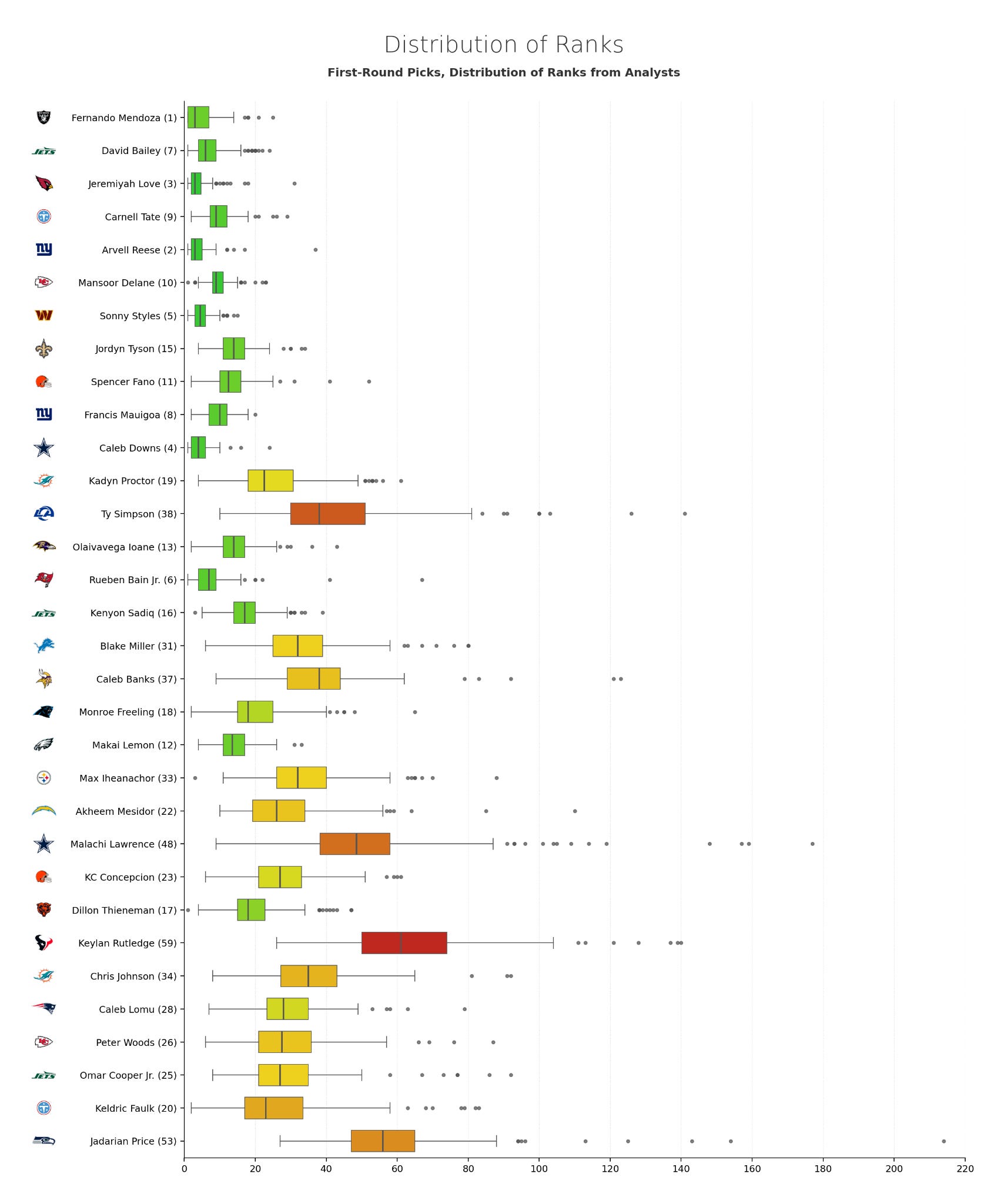
Banks was generally ranked between 29th and 45th among analysts, though there were extremes — three analysts ranked Banks below the 120 mark, and three analysts ranked him in the top 15, including one top-ten ranking.
Usually, with big steals or reaches, the Forecaster board — which consists of analysts who have access to insider information like Dane Brugler and Todd McShay — ranks the steal and/or reach closer to their actual NFL draft slot. That wasn’t the case this time, with the Forecaster board ranking him 40th.
Gridiron Grading was one of the analysts who ranked Banks beyond slot 120, placing him 121st overall. They don’t have a written scouting report, but they do have a card covering some production and athleticism metrics, which we’ll cover in more detail later on.
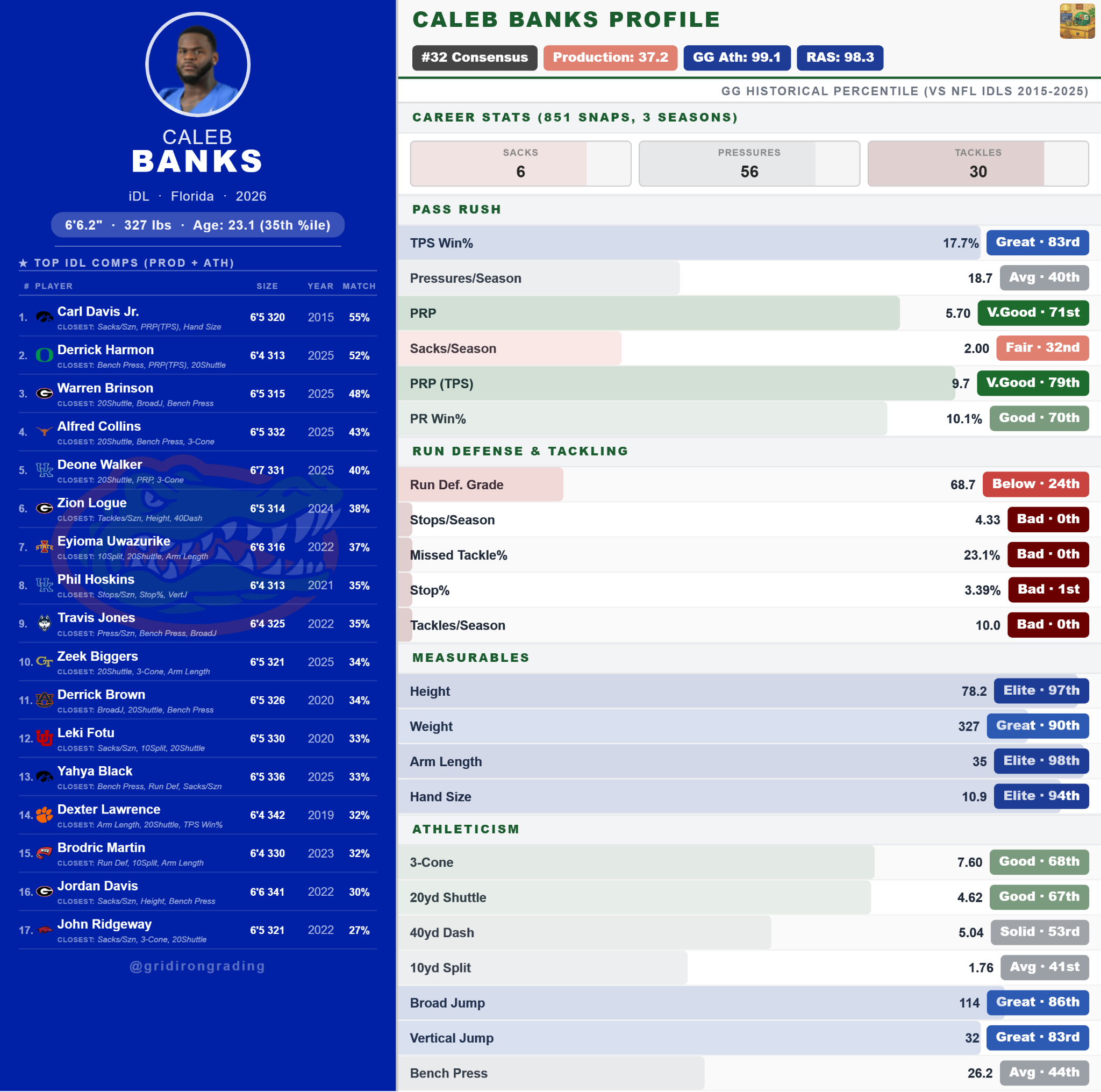
To get good context for the general regard among those skeptical of Banks, we need to find written scouting reports or recorded analysis of Banks. CBS Sports’ Mike Renner, who ranked Banks 92nd overall, has both.
Renner wrote in his big board piece, “No defensive tackle in the class has more impressive reps on film than Banks. When he puts it all together, he looks truly dominant. The problem is those reps are nowhere near consistent. That’s concerning for a player who missed most of 2025 with an ankle injury and has played fewer than 1,000 snaps in his career.”
For CBS Sports, he also recorded a video grading the pick, saying “My lowest grade yet, it’s a D for this pick for a number of different reasons. I think we’ll start with the positives though. Caleb Banks is a prodigious physical talent. He is 6’6”, 327 pounds with an over 7-ft wingspan and his get-off is special. When he gets off low into contact, he can have some dominant reps.”
He added, “Problem is we just never saw it consistently at Florida or throughout his career in college. He only had 14 career run stops over five seasons in college football. And then this past year, he breaks his foot mid-season, comes back, plays a little at the end, doesn’t look like the dominant guy he necessarily did at the end of 2024, goes to Senior Bowl, has an okay week, but then he broke his foot yet again at the NFL Combine, had to have another surgery.”
“So, a big guy with multiple surgeries in the past year who’s never been consistent is just to me too much of a risk to take at number 18 overall, even if his physical tools are at the high end for the position,” he finished.
Joe Goodberry was also a critic of the pick and ranked Banks 79th overall. His scouting report goes over many of the same elements. Impressed with Banks’ athleticism, he wrote, “Caleb Banks has flashes of a super star. He can move laterally and jump a gap at the snap in a blink or he can bull rush right through blockers with ease. The high-end plays are truly incredible.”
“The flashes are what will sell teams, but Banks has a ways to go before he’s that player on a consistent basis. Too often, Banks plays with poor leverage and conditioning,” he adds. He called Banks “one of the worst tacklers we’ve ever seen.”
At the high end, we see Charles McDonald of Yahoo! Sports, who ranked Banks ninth overall. During the Yahoo! livestream of the draft, he said, “He’s got things that you can’t teach. 6’6” 330, and he ran a 5-second 40-yard dash with a 35-inch vertical on the broken foot. I’m a Falcons fan, so when I see that, I think Julio Jones, right? Because that’s what he did back in 2011 when he ran the 4.3 on the broken foot. And he’s got things that are really hard to teach, too, like the block recognition. When your hands and feet are supposed to be synchronized with the defense as the play goes. He’s got moves, he’s got great awareness.”
He caveated with his primary negative, adding, “It’s just the tackling, man. He’s got, what, like two tackles in three games? And I swear to god he could have had 10 TFLs in those games. But he just can’t finish.” Reasoning it out, he said, “I guess they’re probably looking at it like, ‘can Brian Flores teach this guy how to tackle? Because if he can, you’ve got an All-Pro defensive tackle because there’s just not guys that are built like this that can move like that.”
When Andrew Siciliano pushed back, suggesting it’s asking quite a lot for the 18th overall pick to be taught how to tackle, McDonald responded by adding, “But what I don’t have to do is teach him how to read a down block in real time and how to split double teams, and that’s the hard stuff. We can get the framework and the strength and the technique he already has. You can do the hard stuff, why can’t you just tackle the guy?”
Renner’s coworker at CBS, Ryan Wilson, ranked Banks 15th overall on his big board. He didn’t place Banks in his final first-round mock draft, reasoning that the injury could spook teams off of him, but the last time he placed Banks in a mock, he said, “At 6-foot-6 and 330 pounds with 35-inch arms, Banks is surprisingly explosive for his size, playing with power, juice and a nonstop motor. A foot injury sidelined him for parts of the 2025 season, but he took part in all three Senior Bowl practices and was pretty much unblockable on every rep. If he’s fully healthy, he has top-10 ability.”
One of the experts who placed Banks closer to his median outcome, Lance Zierlein for NFL.com, wrote of Banks when ranking him 33rd overall, “Big-framed, long-limbed interior defender whose play needs more polish to consistently match his traits. Banks has a quick first step. He can stun/control single blocks when his hand strikes are timely and accurate, but he needs faster disengagement to increase his tackle count. His high center of gravity allows double teams to generate displacement, so a move to odd-front end could be in his best interest as a run defender.”
“Like a grappler without submission knowledge,” Zierlein wrote, “Banks is still learning to unlock his physical advantages so he can turn them into sacks. His traits and flashes at the Senior Bowl make him an enticing prospect, but injury concerns are a potential stumbling block for him.”
It seems as though, despite his middling variance score for players ranked around 37th overall, Banks was generally regarded as an extremely boom-or-bust prospect.
Why The Low Rank?
A large part of the reason Banks was ranked so low on the consensus board was a tumultuous 2025 season and pre-draft process. Banks broke his foot in Florida’s training camp before the season. He tried to play through the injury, but reaggravated it in his first game, against LSU. He underwent surgery to repair the Jones fracture he had suffered in his fifth metatarsal.
He recovered from that injury and was able to get healthy to play the final two games of Florida’s season, when the team was 3-7. Healthy, Banks attacked the pre-draft process, competing in the Senior Bowl and testing at the Combine. However, during his athletic testing preparation, he broke his foot again, this time a fourth metatarsal fracture. He was able to put up his excellent athletic testing despite that fracture, but the repeat injuries caused his draft stock to decrease.
It’s worth noting that, before the draft, it was reported that Banks expects to fully recover from his second foot injury by June. @Skol_Doc, an actual foot surgeon, provided analysis about Banks’ injury history in this YouTube video. The broad takeaway is that Banks’ injury should not be a major concern moving forward — the Jones fracture seems to have been fully healed, and the fourth metatarsal fracture should be a very clean recovery. Skol_Doc did mention that ultimately, Banks’ weight was a factor for the injury. In athletes, size can contribute to injuries, but do not suggest recurring injury issues.
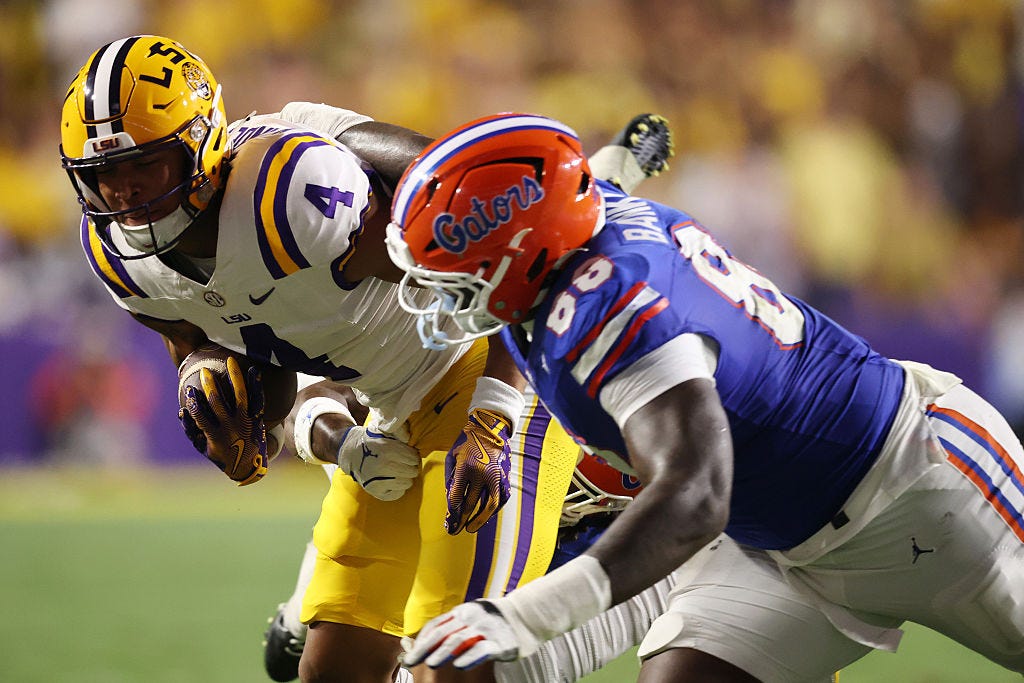
In other words, his weight may have played a role in his foot injuries this time around, but there’s little evidence to suggest that will continue to be the case.
Banks’ injury issues seemingly played a major role in his perception and consensus board ranking. It’s difficult for analysts to rank a player highly after they’ve missed significant time with injury. It’s one thing to bet on a talent who missed a season with injury — like Jermod McCoy, who fell way further than anyone expected — but Banks’ limited season combined with yet another foot injury likely spooked many analysts and dropped him down boards.
Dane Brugler from The Athletic, a plugged-in forecaster who also helps set expectations for many draftniks, provides a great example of Banks’ fluctuating stock. In an in-season top 100, Dane ranked Banks 46th on November 11th. On February 10th, post-Senior Bowl, Banks had risen all the way to 24th on Dane’s board. Then, after the Combine injury, Banks fell again, ranking 52nd overall in the Beast, Brugler’s draft guide.
It’s not difficult to think of players who have fallen down the board due to injury concerns — McCoy this year, Will Johnson last year, or even further back to players like Myles Jack, Jaylon Smith, or Maurice Hurst. Because Banks was hurt during the process, the situation could have hurt his consensus rank without really affecting his draft stock; the Vikings have very publicly stated that they believe the medicals are clean, with interim GM Rob Brzezinski calling the Vikings’ medical staff “the best in the world.”

Without fully built-out consensus board data going back to January, it’s difficult to create one-for-one comparisons that contextualize Banks’ rankings on a theoretical consensus ranking before the NFL Combine to the one published immediately before the draft.
We do have something similar, however. Mock draft data doesn’t serve the same purpose as big board data given that they are meant more to capture predictions than player talent, but they help us here.
The former Florida lineman injured his foot during the Combine, but news of the foot injury didn’t reach the public until March 12. Given that his Combine performance marked him as a “riser” — especially when compared to fellow defensive tackle Peter Woods — Banks’ stock should have improved rather than fallen.
That’s what we see in reporting and in the data. Between the Super Bowl and the Combine, where he was cementing his perceived talent level after a successful Senior Bowl, he was projected to be selected around pick 25. After an outstanding Combine, his floor rose from the 27th pick to the 25th, while his median outcome improved to the 22nd selection. His ceiling projection improved from 19th to 13th, with the Ravens at 14 a reasonably popular pick.
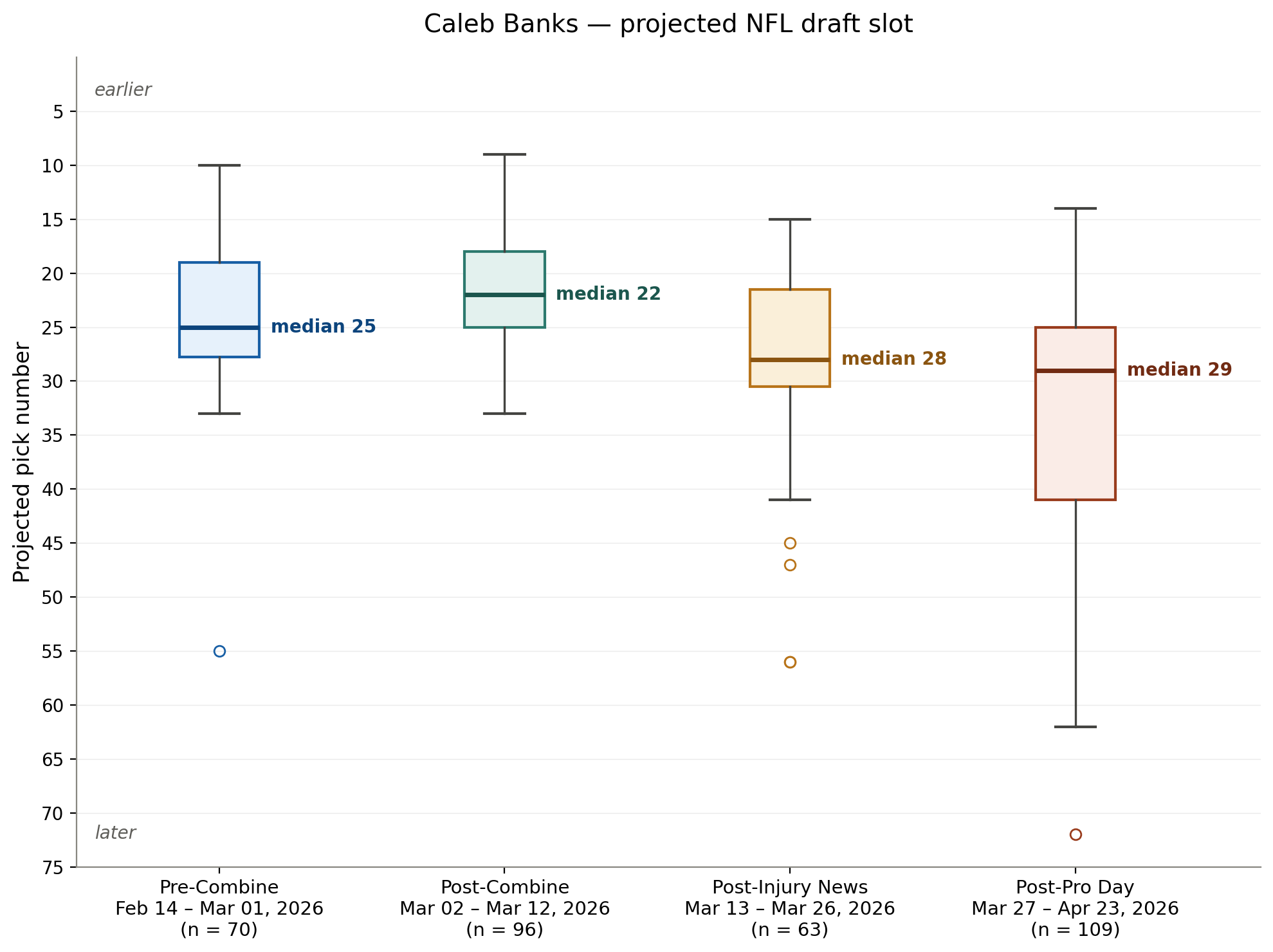
But after the news of the injury broke, his stock seemingly plummeted. His median projection fell from 22nd overall to 28th, and his ceiling dropped to 22. At this point, he was beginning to drop out of the first round with some regularity. After he was seen on a scooter at the Florida Pro Day, his median dropped one more spot to 29th, but, most significantly, his range of outcomes expanded massively. His 25th percentile outcome fell from 31st to 41st, while his 75th percentile outcome dropped from 22nd to 25th.
The four box plots at different moments in the draft process help us understand what happened, but it’s made starker by a two-moment box plot.
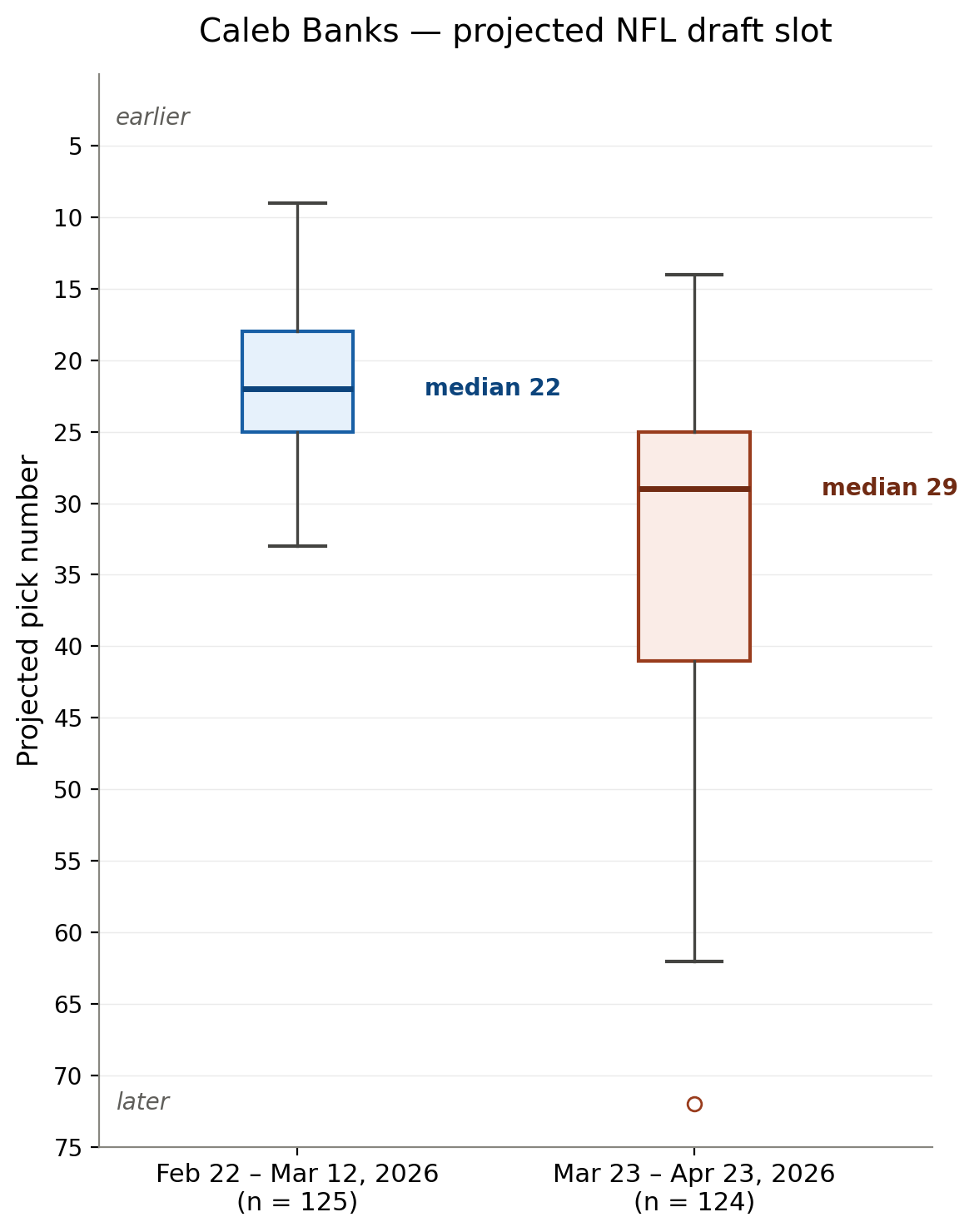
The box plots probably tell the story best, but a weighted line chart might help as well.
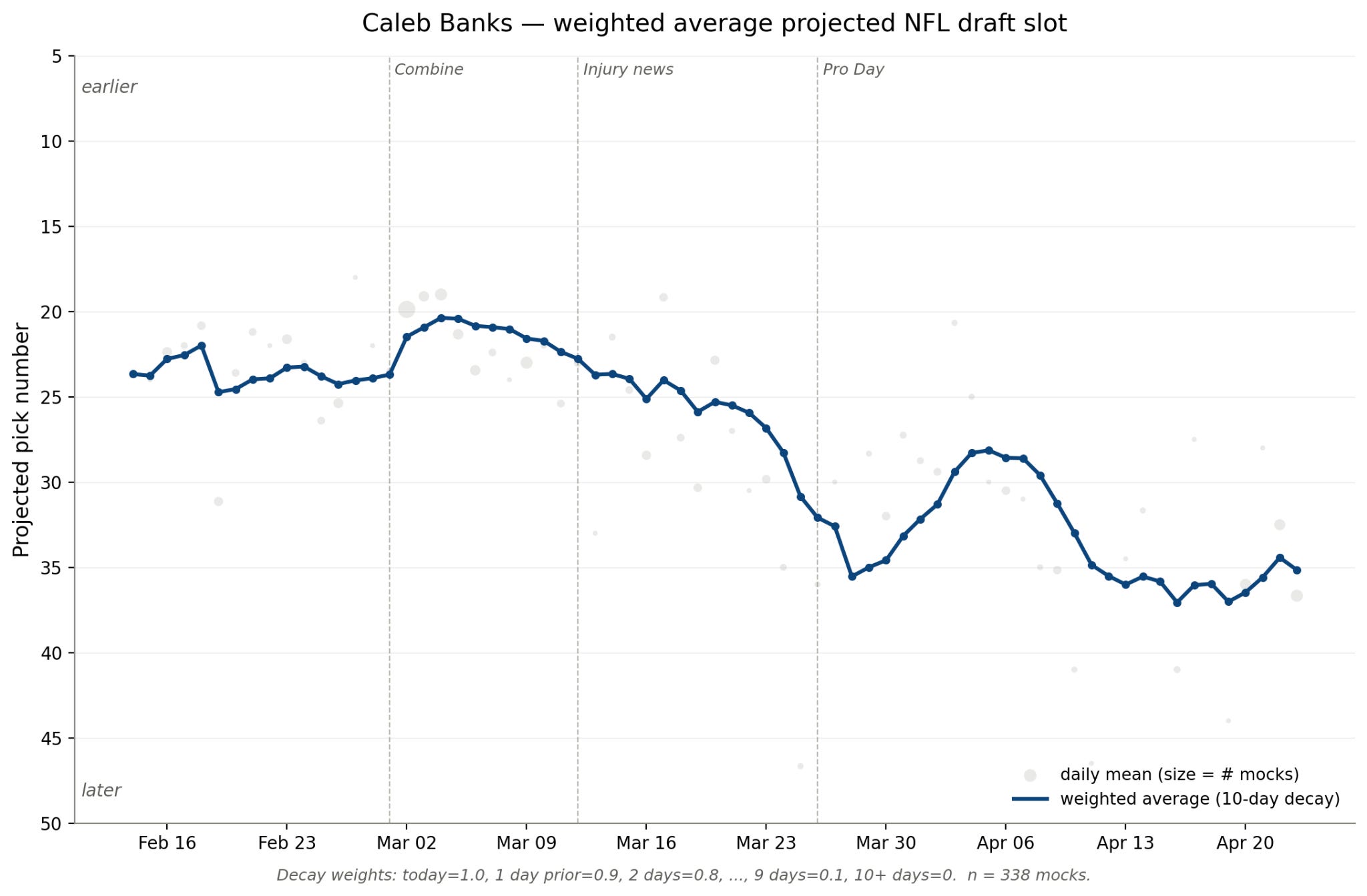
Because of the ten-day delay between his Combine testing and the news of his foot injury, we can be reasonably confident that Banks’ stock was almost entirely due to the news about his reinjured foot.
Athletic Testing
That makes sense because he was an outstanding athlete at the Combine. Banks measured in at 6’6 ¼” and 327 lbs with massive 35” arms and an 85 ¾” wingspan. Despite his weight, he looks very well built on screen, and looks almost slim, which is incredible for a player who weighs 327 lbs. Based on the testing, Banks is an incredible athlete for his size.
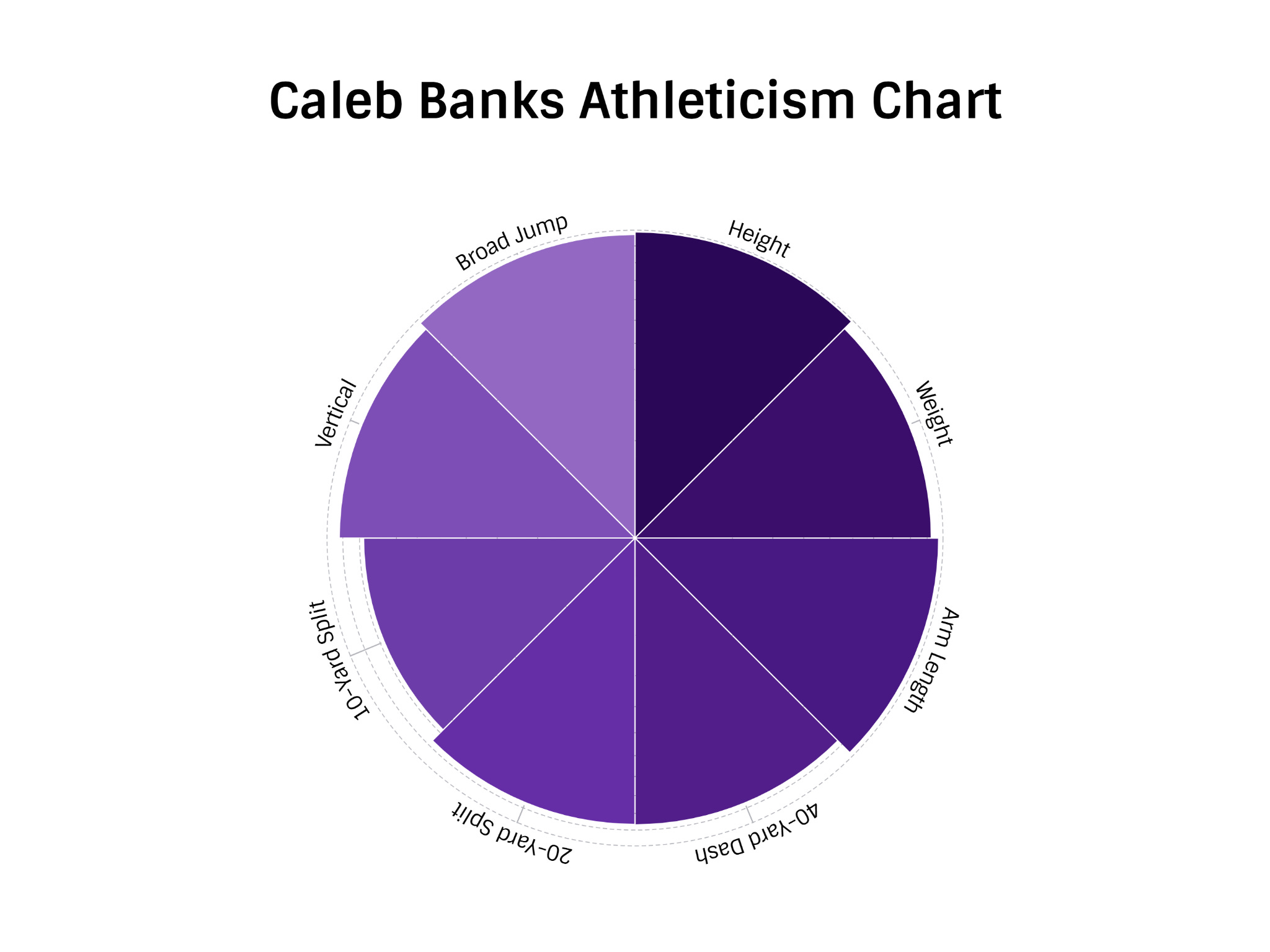
This athleticism chart is weight-adjusted. That means all values are adjusted for the athlete’s height and weight; running a 5.04-second 40-yard dash is significantly more impressive (and meaningful) at 327 pounds than at 285 pounds. His chart is almost completely filled out. Compare that to all the first-round defensive tackles who performed the same workouts as Banks over the last three years.
What is not captured in the chart is the fact that Banks did all of this on a broken foot. He broke his foot before testing at the Combine and the news of the injury didn’t hit outlets until ten days after his 40-yard dash.


While he was listed on the consensus board as a nose tackle — something his size might suggest — he won’t play that role for the Vikings. Banks said during his introductory interview that he is expecting to play defensive end in the Vikings’ system, which is similar to the role Jonathan Allen played last year.
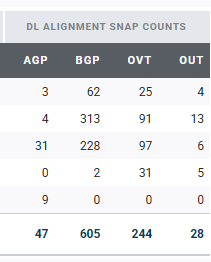
The Vikings took a true nose tackle in Domonique Orange in the third round, solidifying that projection. That role matches the alignment Banks played at Florida, where he spent the vast majority of his time in the B gap, per PFF. Banks’ upside case is more like Chris Jones — another tall, long interior player — than a true nose like Dexter Lawrence.
It is important to note that this is not a complete athletic profile. Any reasonably solid athletic profile that aims to project defensive tackle performance — especially for pass-rushing tackles — will need to incorporate agility scores.
The evidence suggests that three-cone times help project outcomes for three-technique tackles, four-technique defensive ends and edge rushers. Good examples include both Sheldon Richardson and Geno Atkins, who ran very quick three-cones at 7.33 seconds; Atkins did so in 2010 and Richardson did so in 2013.
Gerald McCoy posted a 7.32-second time in 2010 in the same class as Atkins and Ndamukong Suh, who ran it in an astounding 7.21 seconds. Calais Campbell ran a blazingly quick 7.19-second three-cone in 2008. Aaron Donald ran it in 7.11 seconds in 2014, Kobie Turner ran it in 7.08 seconds in 2023, Fletcher Cox ran it in 7.07 seconds in 2012 and Milton Williams ran it at 6.95 seconds in 2021.
J.J. Watt, who started his career as an interior defender, ran it in a shocking 6.88 seconds. Most of the high-level pass-rushing defensive tackles you’ve seen play have run outstanding three-cone times.
So, we don’t have that. Banks seems like he moves well and we could argue that his weight-adjusted three-cone would likely be good. But that is just speculation — many defensive players have been described as athletic who have put up mediocre athletic testing numbers.
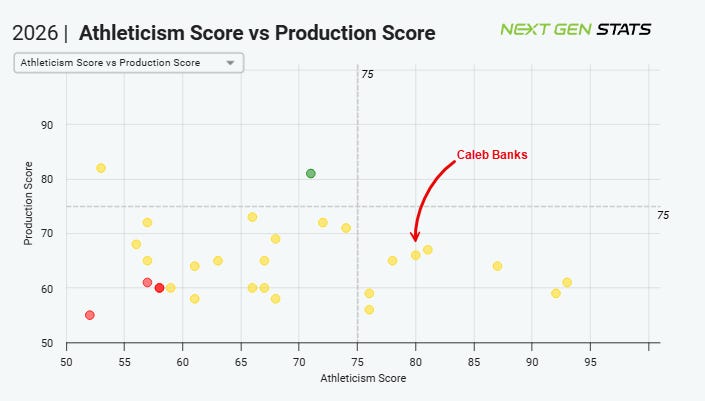
For what it’s worth, Next Gen Stats has an athleticism score that combines proprietary information, like access to on-field tracking data, along with tested athleticism. Within those scores, he produced an “80” out of 100 for their athleticism score metric.
Production
From an analytics perspective, evaluating a player with production in mind gives us a bit more to work with to figure out what they can do and the odds of their success. Obviously, the final year of production doesn’t tell us much for Banks, who only played three games in 2025.
Those games won’t even provide very much as some of them came after he returned from injury and there seems to be evidence his explosiveness was limited by that injury — something that did not seem to be the case when he was more fully recovered when practicing at the Senior Bowl.
At first glance, Banks’ production in 2024 was pretty good. His 13.0 percent pressure rate ranked eighth among all defensive tackles in Division I college football, and his pass rush win rate ranked in the 93rd percentile. When isolating snaps without screens or play-action with true dropback passing, he retains that high-level win rate and pressure rate, ranking fifth in pressure rate in those situations.

 | A guest post by
|