

The Kwesi Konundrum: Why Did It Play Out Like This?
The Minnesota Vikings, bafflingly, let go of their general manager in late January. It may have made sense to let him go at season's end, but the timing and reporting is puzzling. We break it down.

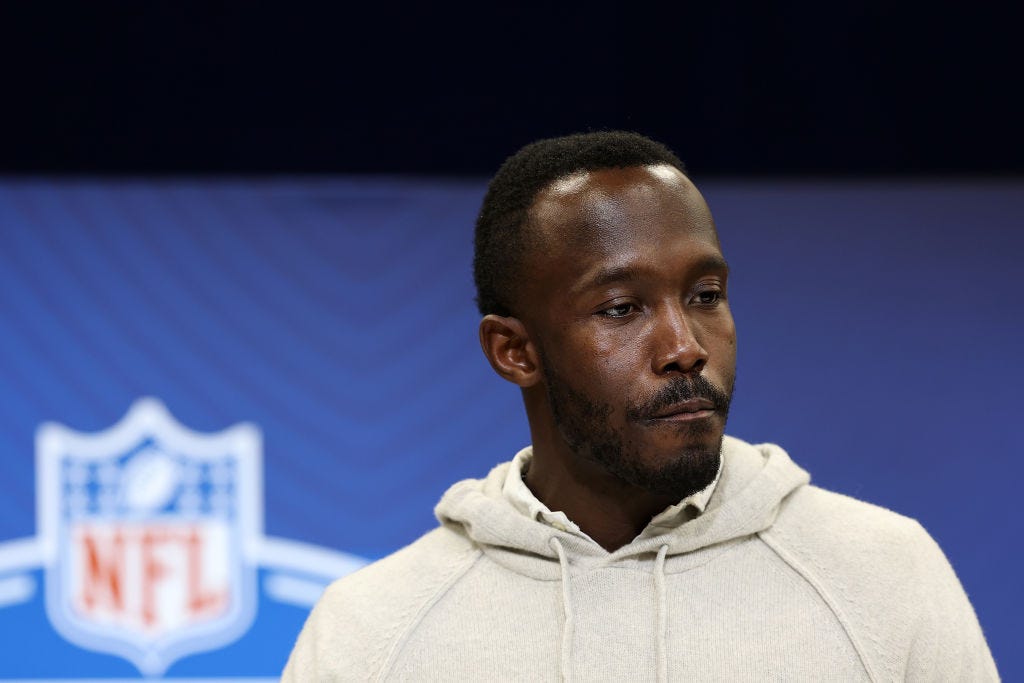
On Friday, January 30, the Vikings announced that they had let go of their general manager, Kwesi Adofo-Mensah. Notably, Friday is an “off-day” in the all-star schedule. Media and general managers often travel from Mobile, Alabama, to their homes after watching practice all week at the Senior Bowl.
Adofo-Mensah was among them, meeting with players, scouts, members of the media and friends on other teams.
The timing was bizarre; the Vikings decided to let go of their general manager weeks after the season had ended and missed out on the traditional hiring cycle. The Falcons announced their front office hires — Matt Ryan and Ian Cunningham — on January 10 and January 26, and the Dolphins announced their new general manager, Jon-Eric Sullivan, on January 9.
There aren’t as many openings this year for a general manager as there have been for coaches, so this scheduling may not inhibit their search as much as letting go of a head coach would, but it’s still strange that the Vikings waited three weeks to let go of their GM, having him work the entire time.
As the Athletic’s Dianna Russini and Alec Lewis reported, one team source told them that the timing was more shocking than the fact of his firing. Their piece outlines a level of confusion in the organization; Mark and Zygi Wilf, the team owners, conducted a thorough review of the team following the season and, after hearing scathing reviews from various personnel inside the building, seemingly decided to wait for several weeks before letting go of their former general manager.
People in the organization thought that, without changes, Adofo-Mensah was safe for one more year. Surely, he thought the same.
It was strangely cruel to have him take a work trip to Alabama.
In this piece:
Why Did the Vikings Fire Kwesi Adofo-Mensah?
Perhaps the less interesting of the two questions is why the Wilfs decided to let Adofo-Mensah go at all. Journalism on the subject paints a broad picture, with a dizzying variety of factors contributing to the decision.
There is good reason to let go of Adofo-Mensah, but leaks from the organization suggest a lack of focus on identifying the reasons for his departure. Russini and Lewis’ report renders a short-term picture; one disappointed by the decisions Adofo-Mensah made in securing higher-quality quarterback play for the 2025 season.
Quarterbacks Anonymous
The failure to re-sign Sam Darnold, who is about to make his Super Bowl debut with the Seattle Seahawks, appears in much of the reporting we see about the Vikings’ GM decision. More prominent, however, is the inability to re-sign Daniel Jones, who left for the Colts and produced an outstanding season before his injury.
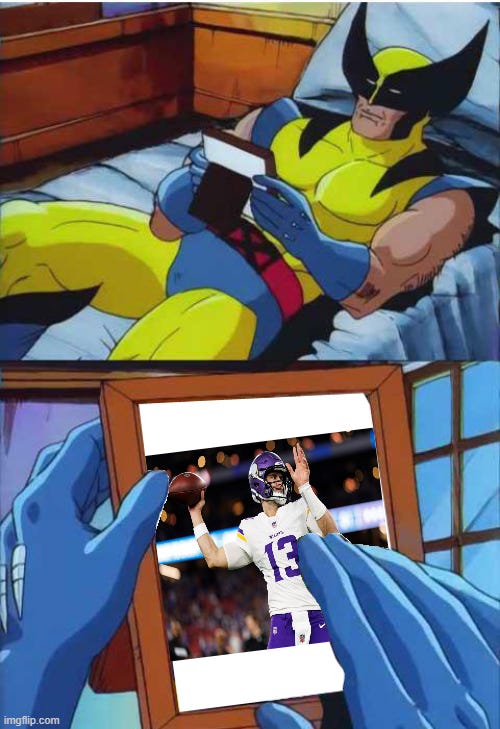
While Matthew Coller’s piece on Adofo-Mensah’s firing mentions Darnold, as does Kevin Seifert’s piece at ESPN, they and other reports focus a bit more on the Jones misstep. Though, as Coller points out, it’s kind of a difficult “misstep” to focus on. It’s been well-reported that the Vikings offered more total money and more guaranteed money than the Colts. It had been reported at the time and more recently in wake of the Adofo-Mensah news that both Kevin O’Connell and Adofo-Mensah expected to be able to retain Jones and were surprised when he informed them he was taking the Colts offer.
The reasoning is obvious; Jones was guaranteed a path to genuinely compete for the starting job in Indianapolis after Anthony Richardson fell out of favor, while there was no such guarantee for Jones in Minnesota.
Pinning Adofo-Mensah for this failure, as team sources seem all too willing to do in light of his departure, seems baffling. Jones’ issue didn’t have anything to do with contract items in the general manager’s control; only a coach like O’Connell could effectively reassure Jones that he would earn a genuine competition for the starting role. If anything, losing Jones would be O’Connell’s fault, not Adofo-Mensah’s.
On top of that, the decision not to pursue Aaron Rodgers — more a focus for Russini in her reporting than for many other journalists — doesn’t seem like one worth getting twisted into knots for. It is the case that Rodgers was a much more efficient quarterback in Pittsburgh than J.J. McCarthy was in Minnesota and it seems to be settled fact that he’d have signed a below-market deal with the Vikings.
But getting bent out of shape that the Vikings didn’t get the 23rd-ranked quarterback in EPA per play seems like poor process. Surely, the Vikings would have won more games with Rodgers at the helm rather than Wentz or McCarthy (though, notably, Wentz and Rodgers rank right next to each other in EPA per play), but likely not that many more — enough to get bounced out in the first round of the playoffs, again.
ESPN’s Adam Schefter reported that the Vikings were never close to offering Rodgers, with colleague Jeremy Fowler backing up that reporting with his own report that Rodgers wanted the Vikings, but people in the building weren’t seriously considering it.
All of these reports circle around the idea that there wasn’t reason to be sold on McCarthy heading into the season. Obviously, after the fact, the Vikings shouldn’t have been. But these reports pair with rumors swirling around that O’Connell wasn’t sold on McCarthy as the unquestioned starter.
Only one report — Russini and Lewis’ — seems to suggest that the feeling inside the building was that McCarthy was unready. Strangely, Russini herself reported at various times that the Vikings, including O’Connell, were incredibly confident in McCarthy. That matches what Wide Left had heard about the coaching staff’s enthusiasm for McCarthy back in March of 2025.
When it comes to quarterback decisions, it very much feels like O’Connell played a significant role in how the Vikings mishandled the process, and that Adofo-Mensah is being set up as the scapegoat.
These short-term reasons, which include a disappointing 2025 free-agent class and poor handling of the quarterback situation, hopefully played only a small role in the decision to let go of Adofo-Mensah.

Should that have been the case, then Adofo-Mensah should also have been praised for the decision to let Kirk Cousins walk and the decision to sign Sam Darnold. It might even be worth arguing he was right to trade for both Nick Mullens and Joshua Dobbs. Instead, he gets blame for when the quarterback decisions go sideways, even when he’s arguably not at fault, and doesn’t get credit when those decisions go well.
But that doesn’t mean there weren’t more systemic reasons, good or bad, to let go of Adofo-Mensah.
Paternity Leave and Work-Life Balance
Russini and Lewis also reported that executives around the league were shocked that Adofo-Mensah took paternity leave in the first two weeks of training camp, something Wide Left can confirm. One source used the phrase “abusing paternity leave” to describe Adofo-Mensah’s absence in that time.
The Russini and Lewis report were careful to say it wasn’t the Vikings ownership or anyone in a hiring or firing position who expressed resentment at Adofo-Mensah’s use of parental leave. That would be dicey at best, legally. Instead, it seems as if the report was built around those around the league (“rival executives and coaches”).
Mike Sando of the Athletic, who has extensive contacts in front offices throughout the league, also suggested it may have caused internal tensions, too.
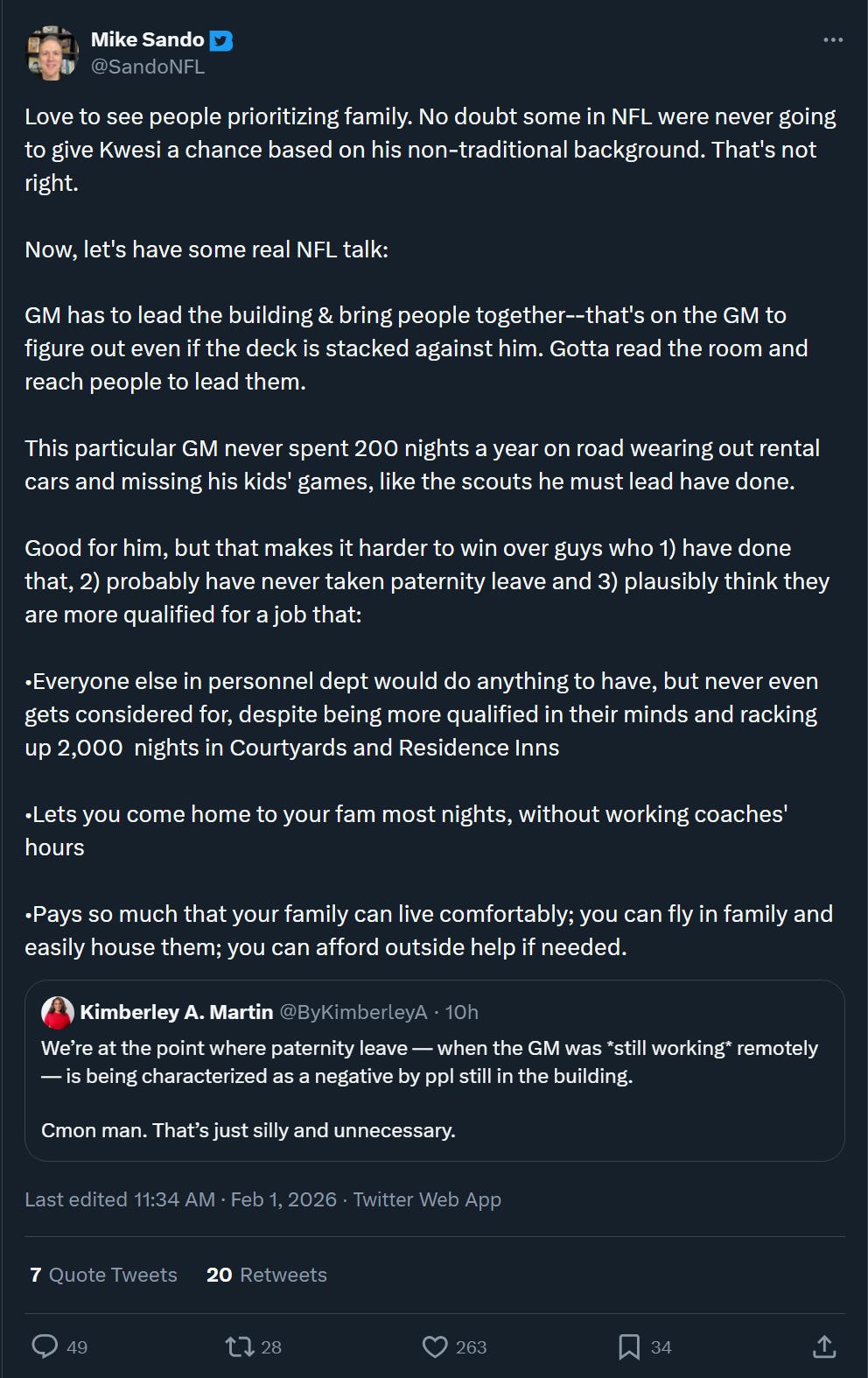
These conversations are just as much about the toxic nature of the NFL as they are about our collective inability to demand better for others when we’ve experienced hardship. Seeing executives who have had to grind through unreal working conditions resent those who have not is both understandable and not particularly useful. Kwesi’s work-life balance does not impact any one else’s across the league.
We could make this about a larger conversation — e.g., some people will never respond to the idea that it may be beneficial to forgive student loans simply because they themselves had to pay off loans — but for the moment, we can locate it inside of football.
Notably, this is clearly more about the perception of working hard than it is about actually working hard. Adofo-Mensah was working remotely during his paternity leave — not a real leave at all!
Ultimately, Lindsay Rhodes is right:
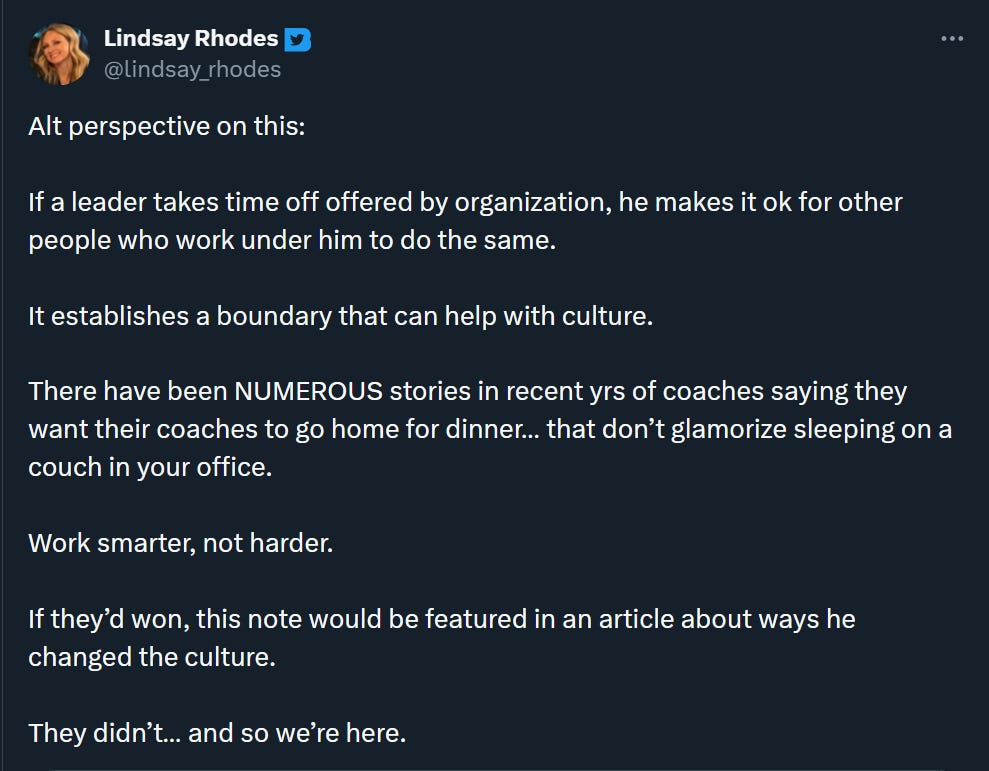
The NFL is famous for running its coaches and executives ragged. There are glowing profiles written about head coaches featuring their demonic sleep schedules — evidence of their work ethic and commitment. One of those profiles only somewhat ironically calls NFL head coaches the “hardest-working men in human history”.
For these overachievers, sleep is for the weak, and dedication is measured by how much time you put into a job. Endurance is a way for someone like the minuscule Jon Gruden to prove his masculinity. Maybe he can’t bench-press 500 pounds, but Gruden can go without sleep for a week.
Coaches are known to wake up anywhere between 3:00 AM and 5:00 AM, often going to bed just a few hours prior. Some coaches sleep in their offices, and some have had beds installed there so they don’t have to waste time going home just to sleep.
The article points out that many perennial losers have this kind of sleep schedule, not just winners. Perhaps the sleepless schedule is a baseline expectation, and the differences come from elsewhere — and coaches who take “normal” sleep schedules will fall behind.
But we have seen coaches draw back their obscene work schedules and succeed. Sean McVay, who in 2017 was the subject of a day-in-the-life article that shared he woke up at 3:45 AM, has since called his absurd sleep schedule a mistake.
Taking the advice they dispense to players about the importance of sleep and work-life balance, McVay, Dave Canales, Jonathan Gannon, Zac Taylor, Shane Steichen and others have reduced their in-facility time and implemented better sleep schedules for themselves and their staff. They might be following in the footsteps of Bruce Arians, who learned from Bear Bryant the importance of sending coaches (and themselves) home so that they can spend time with their families.
All of this is to say that Adofo-Mensah’s (sort of) parental leave genuinely rubbed many people the wrong way across the league. But there’s no evidence it actually reduced his efficacy. We would be talking about it as a positive, not a negative, had the Vikings drafted well.
What if the GM has Bad Vibes?
That said, resentment inside and outside of the organization expanded beyond elements related to the league’s toxic culture.
Based on the limited discussions Wide Left had with multiple analytics staffers across multiple teams in the NFL, there wasn’t much confidence in Kwesi Adofo-Mensah’s approach when it came to a data-forward approach to team management.
Indeed, one analytics staffer called him a “clown” for his approach to team management. These feelings among analytics staffers around the league had been growing over time, but didn’t boil over until this last season, where Adofo-Mensah’s runway had run out among a group of people dedicated to putting data at the heart of their approach. One third-party analytics consultant who has worked with multiple teams called Adofo-Mensah arrogant, a stark contrast to his public-facing personality.
Another source within another organization who has interacted with Adofo-Mensah confirmed this feeling — that his humility was a persona more than an in-built attitude. Multiple people referenced him as someone who had the need to be “the smartest in the room.”
At least one staffer thought that Adofo-Mensah had a strong understanding of analytical principles, but didn’t have the spine to enforce them in his approach. Whether it was a lack of conviction, leadership, or some other factor that prevented him from implementing these guidelines, it was ultimately a failure by someone meant to be a general manager.
Is it unfair that all of this is coming out after he had been let go? Certainly. Some of this is the nature of reporting; it seems unnecessary for journalists to dump on a general manager who might just have poor interpersonal skills while he still has a job. It would be a story without a point. Some people don’t like him, so what?
But, with the added context of his dismissal, there’s more teeth to the story. Interpersonal conflicts, individual quirks, perception and political capital — all of that matters more when we know the end result. These might not be the reason why Adofo-Mensah was let go, not explicitly, but they provide texture to his tenure.
