

The Vikings Down the Cowboys as J.J. McCarthy's Growth Continues
The Minnesota Vikings defeated the Dallas Cowboys in a game meaningless for the standings but meaningful for Vikings fans. Their young quarterback continues to grow.

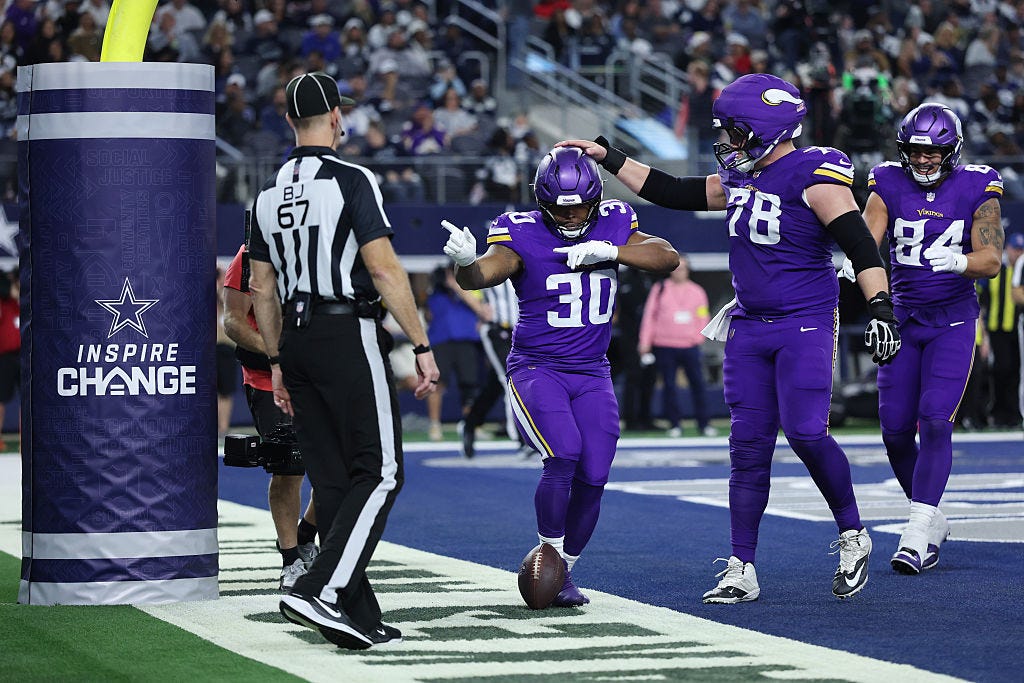
The Minnesota Vikings’ 34-26 win over the Dallas Cowboys doesn’t mean much in the standings; the Vikings were eliminated from the playoffs before the game even began and they changed draft positions by just one spot.
But for football fans, meaning does not always attach itself to standings or draft position. There are certainly Vikings fans who would rather lose the game and secure superior draft capital, but many others prefer to see the team figure out how to win games in their current configuration.
Within that framework, there’s been some hope. J.J. McCarthy, once one of the worst-performing quarterbacks we’ve seen in early quarterback play, has turned into something… positive?
Where’s McCarthy At
The national football-watching audience was introduced to J.J. McCarthy with a disastrous start on Monday Night Football against the Chicago Bears, one that was salvaged by an incredible fourth-quarter comeback.
The comeback overwhelmed the rest of his game in public perception; he even earned NFC Offensive Player of the Week honors. But it didn’t take long for his poor play to dominate the conversation. His play was so poor in just a few games that his injury was treated by some as a potential “soft benching” for a quarterback who wasn’t on an NFL roster when training camps across the league began.
His return from injury didn’t help things, and he put together some of the worst performances we’ve seen any quarterback, with any level of NFL experience, put together. Because they were, to most fans, numbers on a screen instead of a nationally televised game, there wasn’t much McCarthy could do to erase that perception, even after a dominant performance against the Washington Commanders.

So, with a chance to reintroduce himself to a national audience with his actual play, he immediately tipped his own batted pass into a defender for an interception.
That stunning and innovative failure to begin the game wouldn’t set the tone for McCarthy, however. He would go on to have a 63 percent success rate after that, the fourth-highest of Week 15 and a 97th percentile performance this year.
This, along with his performance against the Commanders, has turned the tide on his season-long performance charting.


It would be easy to dismiss McCarthy’s performance as one against a struggling defense; the Cowboys entered the game ranked 28th in defensive EPA per play, a ranking that doesn’t change when looking solely at post-trade deadline performance.
And it would be a fair point to make if anyone were seriously arguing that McCarthy had become a top-tier quarterback on the basis of one game. That’s not the argument; McCarthy had been performing like one of the worst quarterbacks in the NFL and was often the worst-performing quarterback for the particular defense he was playing.
And, well, look:
And that includes the first-play interception. McCarthy’s performance was better than any other quarterback’s performance against Dallas — and the Cowboys have played Patrick Mahomes, Jared Goff, Jordan Love, Jalen Hurts (twice) and fellow second-year players Caleb Williams, Bo Nix and Jayden Daniels.
Playing well against two bad defenses doesn’t tell us that McCarthy is the heir apparent. But it’s such a turnaround from his previous performances, both relatively and absolutely, that it’s worth noting.
It wasn’t just in raw production numbers where McCarthy did well, either. That’s an important distinction; had he ‘produced’ primarily via screen passes where receivers and blockers did most of the work, it wouldn’t tell us much about his ability.
While McCarthy did pepper the short area of the field, he was hardly YAC or screen-dependent. Only 36 percent of his passing yardage came after the catch, and he still managed 10.4 yards per attempt, a relatively elite mark.
His depth of target was fairly aggressive at 11.0 yards downfield, according to Pro Football Focus. Six of his 24 passes went 20 or more yards downfield, and he completed four of those passes at 21.7 yards per attempt.
In the past, the Vikings’ deep-ball tendencies with McCarthy have led to agonizingly long times-to-throw. Heading into his Week 14 matchup against Washington, McCarthy led the league in time to throw at 3.32 seconds, according to Next Gen Stats.
Unsurprisingly, he had the lowest rate of passes under 2.5 seconds at 18.5 percent. That meant he would invite pressure and put stress on the offensive line. While the benefit of this should have been deep passing — and they passed deep often; McCarthy’s deep ball rate ranked third in the NFL before Week 14, and he had the longest depth of target — it wasn’t effective.
Against the Commanders, McCarthy accelerated his internal clock and got rid of the ball quickly against a rote zone defense that was ultimately predictable. He didn’t throw deep that often, and his depth of target was a mere 7.5 yards downfield (according to PFF), which is fairly safe.
In short, the Commanders performance had significant positives but left glaring holes in our ability to evaluate McCarthy’s progress.
