

Wide Left Awards: MVP, All-Pro Teams, Coach of the Year and More
Wide Left team came together to vote on the Most Valuable Player, Players of the Year, Rookies of the Year, Most Improved Player, Comeback Player of the Year, Coaches of the Year and our All-Pro Teams


The people at Wide Left — myself, Alex Katson, Devin Jackson, Dante Collinelli, James Foster, Matt Fries, and, reluctantly, Luke Braun — have put together our year-end awards list, including MVP, our All-Pro teams and more.
The goal is to produce deeply positioned approaches to the awards, like we did last year. We’ll likely have different MVP picks from most of the sportswriting community every year, and our approach to every award is deeply thought out. We hope you agree!
Let’s get started.
Awards
Our Yearly Preface: Don’t Just Hand Them to Quarterbacks
I’ve often held that we shouldn’t just hand the MVP to quarterbacks. I’ll just repeat what I wrote last year.
In accordance with my take that we should not be automatically doling out the MVP to the best quarterback in the NFL, I’ve decided to broaden our scope and discuss who the best player in the NFL is this year. From that piece [two years ago] on the MVP award:
We do ourselves an enormous disservice by focusing on the word “valuable” in the MVP award. Historically, the award has gone to the most high-profile player in the NFL, often a quarterback but many times a running back and occasionally a defensive player (and once a kicker).
Since 2013, it’s only been given to quarterbacks. And that is tremendously boring. We already have an award for quarterbacks — it’s the All-Pro award at the position. If we need to, we can award individual positions with separate trophies like they do in college football.
But the holistic, year-end award that used to colloquially mean “the best player in the NFL” — even if it never truly meant that — now must go to one position. When no one at the position is compelling, we shy away from giving it to outstanding players at other positions.
These are much more interesting conversations that would allow us to better understand the demands of each of these positions or recognize players who separate themselves from the pack in bigger ways than passing EPA. Aaron Donald and J.J. Watt deserved multiple MVP seasons.
We have very detailed discussions about quarterbacks because of Brock Purdy’s candidacy. We did the same thing in 2012 with Griffin and 2016 with Ryan. In 2015, there was a conversation about quarterback running value or inflation of one-yard touchdown totals with Cam Newton. We added overall running value to our understanding in 2019 with Jackson.
Those rich conversations would allow us to more deeply examine questions about system fit and offensive linemen (the Evan Mathis question), supporting cast and running backs (do McCaffrey or Derrick Henry create their own production?) and the impact of late-winning pass rushers like Danielle Hunter when compared to early winners like Garrett.
Otherwise, we could be as literal as possible and award the player by dividing total quarterback EPA by salary cap impact. A literal reading of the award would only allow us to recognize high-performing quarterbacks on rookie contracts — a most-underpaid award.
A literal reading of the award forces us to debate between statistically underwhelming quarterbacks and compare them to quarterbacks whose film doesn’t astound. Let’s celebrate the best player in the NFL by giving them the award for being the best player in the NFL.
This year’s MVP candidate was easy to select for our voters, who were instructed to keep things position-blind throughout all of the words except the All-Pro voting.
MVP: Myles Garrett, EDGE Cleveland Browns
All seven voters included Garrett on their ballots, and six of them ranked him first overall. He would have likely won the award had he not broken the official NFL sack record in the final game, simply because of how dominant he was throughout the season, regardless of one sack here or there.
He leads the league in double-team plus chip rate (the rate at which he is chipped by an eligible receiver releasing into a route on pass rushes plus the rate at which he experiences a “true” double-team with two blockers fully committed to stopping him) and still ranks second in the NFL in pass-rush win rate, according to Pro Football Focus.


The fact that he saw more attention devoted to him than any other defensive player while producing league-leading statistics is nothing short of remarkable. Besides J.J. Watt, other players in record-setting sack position didn’t see this level of attention and multicapable production.
Garrett was doubled or chipped on 57 percent of his pass rush attempts this season. By comparison, T.J. Watt was doubled or chipped on 31 percent of his pass rush attempts in his historic 2021 season.
OPOY: Drake Maye, QB New England Patriots
It is difficult to fully capture how excellent Drake Maye has been this year. Criticisms of his play are only relevant when compared to other elite quarterbacks; Maye’s foibles are contextual to being the best we’ve ever seen, not among a very good crop of players this year.
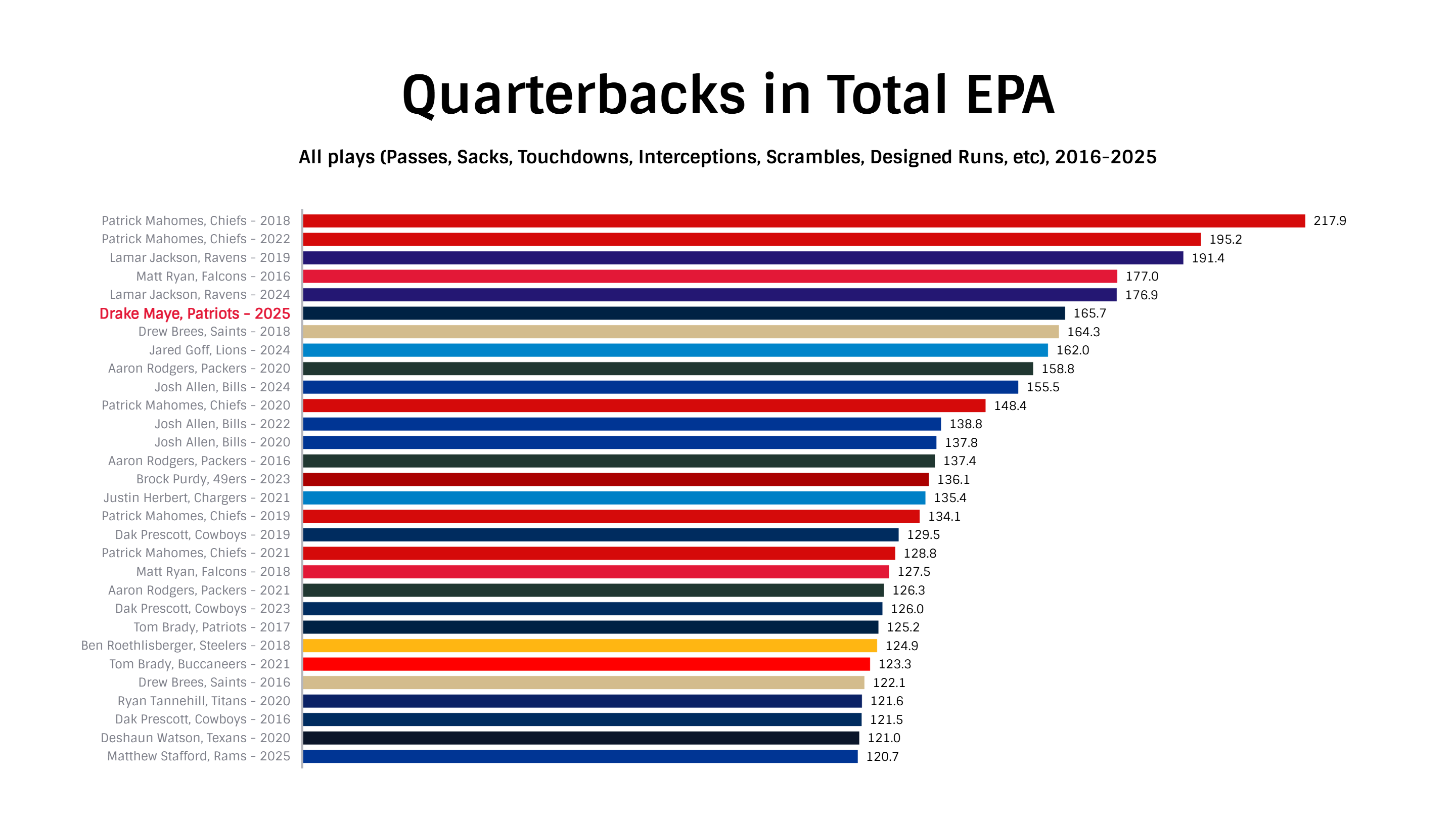
Maye ranks sixth in total EPA generated on quarterback plays in the last decade, and on just passing attempts alone, ranks second. His ability to pin passes to receivers despite throwing deep downfield — even with an average receiver corps and offensive line — is among the best we’ve ever seen.
Next Gen Stats has calculated the likelihood that any particular pass will be completed, accounting for how far downfield the throw is, how close to the sideline the target is, how close the nearest coverage defender is, how much pressure there is on the snap, and more. The difference between the expected completion rate and the actual completion rate is the “Completion Percentage Over Expected,” also known as Completion Plus/Minus.
Maye, because of his accurate deep-downfield throwing, has the best Completion Percentage Over Expected in Next Gen Stats history, which goes back to 2016.
Maye led the league both in average depth of target and completion rate. I don’t think I can ever recall a season like that in NFL history.
Sure, Maye could probably stand to take fewer sacks, and he could slightly carve down his interceptable throws, but these “flaws” only exist when comparing his season to those like Patrick Mahomes’ 2018 or Peyton Manning’s 2004, not to his same-season contemporaries.
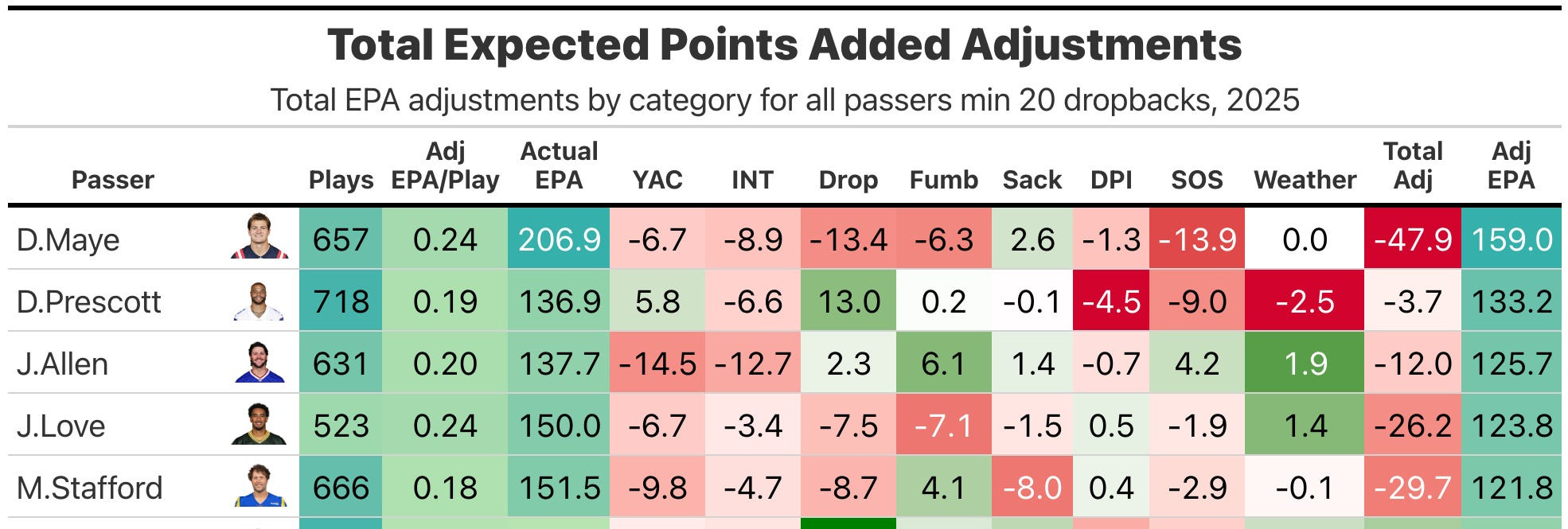
While the argument about his genuinely soft schedule is valid, a holistic correction for elements like opposition, weather, supporting cast, interception luck and so on still places Maye ahead of an impressive quarterback like Matthew Stafford.
Kevin Cole did much of that work at Unexpected Points and it makes a remarkably clear case.
He’s more than good enough to take home the title this year.
DPOY: Jeffery Simmons, DT Tennessee Titans
It’s an enormous credit to Jeffery Simmons that he earned Defensive Player of the Year in our voting over players like Will Anderson Jr. and Micah Parsons, who were in the running. And Simmons ran away with the voting in our field; he appeared on all but one ballot and earned first-place consideration in all but two ballots.
It makes sense, too. Simmons has seen nearly the same attention from opposing offenses that Garrett has received.


For years, Simmons had been flirting with nearly-elite status as a defensive tackle as bigger names like Aaron Donald and Chris Jones took the spotlight, with occasional appearances from defenders like Cameron Heyward, Quinnen Williams and Dexter Lawrence.
This year, it’s been Simmons’ time to shine. Or it would have been, had the Tennessee Titans been able to surround him with more talent.
Like with Garrett, however, that makes his success even more impressive. In addition to seeing significantly more offensive attention than his teammates, Simmons has also had to deal with one interesting problem: he can’t easily accumulate pass-rush statistics like sacks, hits and hurries because teams are running the ball against the Titans after accumulating early leads.
Nevertheless, Simmons leads all defensive tackles in quarterback sacks and hurries, placing second in total pressures of any type. The number one player in QB pressures, Zach Allen, had 90 more pass-rushing snaps than Simmons. In fact, all of the other defensive tackles in the top five had 30 to 100 more pass-rushing snaps than the Titans tackle.
He ranked first in PFF win rate among defensive tackles and second in ESPN’s win rate metric. He also ranked first in PFF win rate when only looking at “true pass sets,” which are passing plays that include plays where the quarterback spends between two and four seconds in the pocket, when it’s a standard, non-play action or non-screen dropback and when there isn’t a rollout or two- or three-man rush.

Simmons hasn’t been as strong as some other pressure producers in the run game, but he’s still a top-15 player in run-stop win rate among defensive tackles despite the problems facing the Titans.
