

A Comprehensive Minnesota Vikings Mock Free Agency
Matt Fries has spent the last several weeks diving deep into the Vikings offseason and reading the free agency tea leaves. With all of that in mind, he produced an exhaustive mock free agency.

The NFL’s content machine keeps on churning.
It’s been less than a month since the Super Bowl, but everyone has already moved on. With the NFL Combine last weekend, draft season is in full swing, but there’s another high-profile event before the NFL Draft takes place: free agency. It’s somehow almost here.
The NFL’s free agency period officially starts on March 11, but the “legal” tampering period starts two days before that on March 9, so we’ll soon be hearing about deals teams have struck. The “illegal” tampering is likely already in full swing; the NFL Scouting Combine, which doubles as a convention for team personnel and agents, sees those teams and agents interact late into the night in the back rooms of Indianapolis. Agents leave the festivities with an understanding of what their clients will command next week, and teams leave with a good idea of who they could acquire.
Minnesota Vikings interim GM Rob Brzezinski will have his work cut out for him as he tries to improve the roster. The team has several holes and is well over the salary cap for 2026. The NFL has finalized its salary cap at $301.2 million for the 2026 season, which means the Vikings are $45.5 million over the cap, per OverTheCap.
To be fair, the team can easily move money around to get cap compliant, and Wide Left has covered how the Vikings can get under the cap, which impending free agents the team should keep, and what needs the team will have heading into free agency. This piece will combine those moves and dive into available outside free agents, creating a full mock free agency for the team.
Author’s Note: I want this exercise to be as realistic as possible, but it is not necessarily a prediction. In some of these situations, I’m suggesting a move the team is unlikely to make, but it’s the better choice. There are many winding paths, and at some point, you just have to make a decision. Information on the salary cap and existing contracts comes from OTC. For contract projections, I projected the structures myself, but I used multiple resources to determine contract values, including PFF’s projections by Josh Queipo, The Athletic’s projections by Daniel Popper, and, when those were missing, player value judgments from OTC and Spotrac.
Vikings’ Current Cap Situation
As mentioned above, the Vikings are roughly $45.5 million over the cap. More specifically, OTC lists them as $45,506,353 in the hole. This is their current cap space under the top-51 rule, which is how the NFL operates in the offseason: only counting a team’s top 51 cap hits. However, there are additional cap hits the team needs to account for when considering the entire season.
Some teams have fewer than 53 players on their roster. Those teams will need to account not only for 51 total players but also for 53, because that is how many players will be on the team on roster cutdown day, all of them counting against the cap. OTC has the Vikings listed with 54 players on their roster, so they don’t necessarily have to worry about that specific issue, but a small adjustment needs to be made to OTC’s accounting.
Harrison Smith’s contract is set to void, which means he will no longer be on the roster. However, OTC’s projection includes his $4.3 million cap hit among the team’s top 51. So, to accurately account for Smith not being on the roster, you need to subtract $885,000 from the Vikings’ available cap.
Like many, I’m expecting Smith to retire with a post-June 1 designation, which means he will count $4.3 million in dead money against the Vikings’ cap in 2026 and $9 million in dead money in 2027, matching the current OTC projection. However, the OTC projection is strange because the $4.3 million projection includes a $1.3 million salary, which is the league minimum, which the team wouldn’t owe Smith if he retires. I also have some confusion about the $9 million dead cap hit in 2027 because the prorated bonuses past 2026 sum to $7.6 million, so the Vikings may have more cap space to work with by the amount those numbers differ.
The Vikings will also need to account for the salaries of their draft picks in their salary cap projections. They technically don’t need to worry about them until the drafted players are signed, and obviously, the team can still trade picks, changing the exact totals, but the team’s draft class is expected to cost an additional $5,029,009 against the cap.
Subtracting those two numbers from the Top 51 total gets you what OTC calls “effective cap space,” but it’s still important to consider in-season operations for the team. You can add $1.77 million for the minimum salaries of two players to get the team to 53 total players, but you also have to account for the practice squad.
Practice squad salaries count against the cap, and the standard practice squad salary is $247,500 for 2026. The team can also pay two players an extra stipend of up to $411,300 to be on the practice squad in 2026. The practice squad consists of 16 players, so assuming the Vikings use the larger number to the fullest, staffing the practice squad will cost $4,287,600.
If you count all of these odds and ends, you get to what I consider to be the “operating” cap space for the team, which means that they’re currently $57,477,962 in the hole.
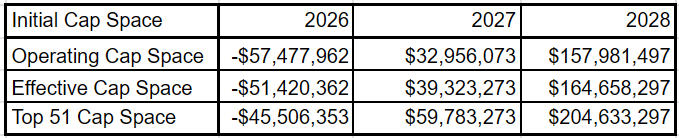

Author’s note: At the end of all of the moves in this piece, my goal is to get that operating cap space number above zero. The Vikings will have more costs than just the ones listed above during the season, particularly for replacing players who go on IR, but there’s no way to guess what the additional burden would be right now. They will also gain cap space by cutting or trading players that I am not predicting right now, so I think it will roughly cancel out anyway.
Creating Cap, Part 1 — Releases
There are three ways the Vikings can create cap space with an existing contract: releasing the player, signing the player to a contract extension, or restructuring the player’s contract to move cap hits into the future.
We’ll start with the most extreme option: cutting players under contract for cap relief. Let’s dive into each of the moves.
If you want to be pedantic, you could count trades and pay cuts (which I consider to be different from restructures), but I’m not projecting either in this piece because I can’t project other teams’ willingness to take a player via trade or a player’s willingness to accept a paycut. As a spoiler, I do have the Vikings adding one player via trade.
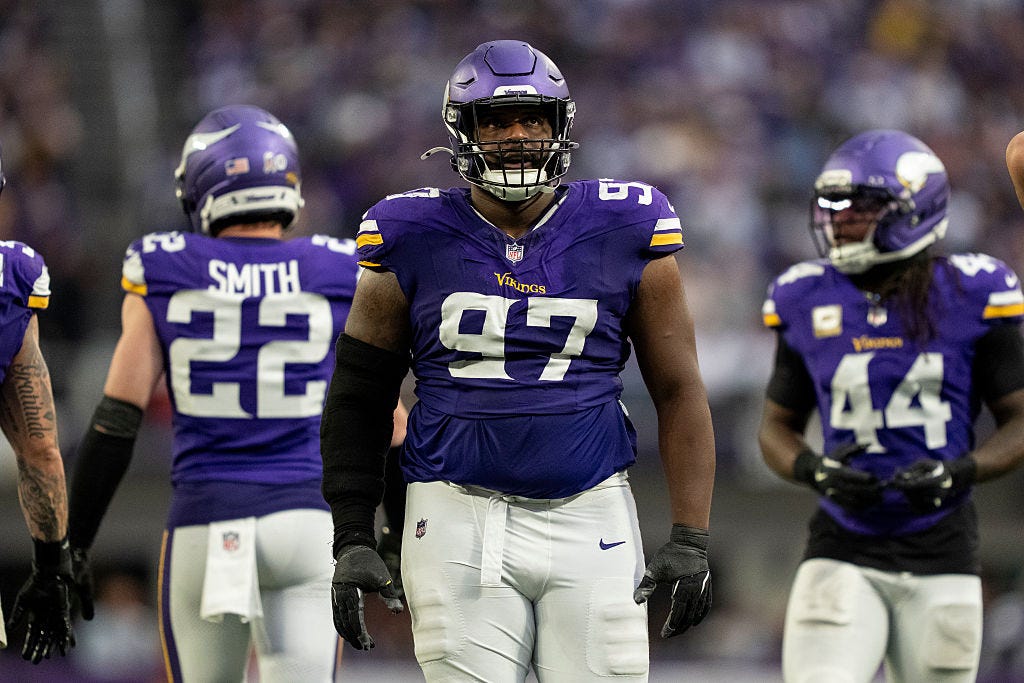
Release DT Javon Hargrave
Salary Cap Impact: -$10,955,882 mil in 2026
The biggest decision the Vikings’ front office has to make before free agency is what to do with their DT room. Hargrave, along with Jonathan Allen, are aging veterans the team added on large contracts last offseason.
Both had their moments last year, but neither lived up to the large salaries that they have in 2026. It seems as though the team has already made its choice, as Adam Schefter reported that the Vikings will release Hargrave and RB Aaron Jones if they can’t find trade partners.
I, maybe paradoxically, would choose to move on from Allen and keep Hargrave. While I think Allen is a better all-around player, Hargrave’s pass-rush ability is harder to find, especially in this year’s free agency class (as we’ll get to later).
Cutting Hargrave saves $10,955,882 in 2026, $4,422,550 more than Allen would, but it costs $18,089,118 more against the cap in 2027 because Allen will still be under contract. If the Vikings find a trade partner for Hargrave, they’d save an additional $4 million in cap space due to his guaranteed salary, which would be a nice benefit.
Running 2026 Operating Cap Space Tally: -$47,407,080
Release RB Aaron Jones
Salary Cap Impact: -$7,750,000 mil in 2026
Jones is 31, well past the age most RBs continue to produce. He’s been plagued with injuries throughout his career and missed five games last year due to them. While Jones was still effective when healthy, he is past his peak, and his $10 million salary is high for an RB, especially one with age and injury concerns.
While I decided to release him, the Vikings should strongly consider retaining Jones. I like how Jones, as the lead back, pairs with Jordan Mason. I would not want Mason to be pushed into lead duties, so even if the Vikings move on from Jones, they should bring in another back who is an explosive runner and offers value as a pass catcher and protector to split time.
Mason is a consistent between-the-tackles runner and a bigger back who can grind out additional yardage. However, he doesn’t have the speed to generate explosive runs and adds next to nothing as a pass catcher. When I watch Mason pass block, his technique and approach are good, but the results were atrocious last year in terms of allowing pressure. With CJ Ham also retiring, the Vikings need someone they trust in protection on third downs.
Therefore, I would want any RB the Vikings bring in to be an explosive player who was trusted in pass protection, severely limiting the options. Depending on who they think they can get, that might bring them right back to Jones. I’d be willing to keep Jones at his price tag in that scenario, but would also expect the team to ask Jones to take a pay cut, and hope he accepts.
Running 2026 Operating Cap Space Tally: -$40,542,080
Release C Ryan Kelly
Salary Cap Impact: -$8,347,647 mil in 2026
Kelly was good when he was on the field last year, but the multiple concussions he sustained in 2025 put his future into doubt. Kelly could easily decide to retire, which would save the Vikings just as much money as a release would.
From the Vikings’ perspective, releasing Kelly would create a need at center, but it’s worth it because the likelihood of another injury making Kelly unavailable represents a massive liability.
Running 2026 Operating Cap Space Tally: -$33,079,433
Retain and Do Not Restructure TE TJ Hockenson
As free agency is approaching, one of the biggest drumbeats around the Vikings has been that they’ll do something with Hockenson’s contract, whether that’s a release or trade.
The Athletic’s Alec Lewis (who does great work) has been throwing out the idea of lowering Hockenson’s cap hit. Lewis is plugged into the team, so I’m sure that the Vikings are strongly considering that as an option.
In the best-case scenario, Hockenson is willing to take a pay cut, and the team does not have to cut him or move money into the future on his contract. As I mentioned above, I don’t want to project pay cuts because I can’t predict whether a player will accept one. If Hockenson doesn’t, I would not cut him or release him.
The number being discussed is Hockenson’s cap hit, which is nearly $21.3 million in 2026. That’s the highest cap hit for any TE, so when Hockenson isn’t the best TE in the league, it is easy to say that number is too much.
However, talking about the cap hit that way doesn’t make sense. Ultimately, the Vikings owe Hockenson $16 million in cash this season, not $21 million. The additional cap hit is due to pro-rated bonus money they can’t control. When looking to free up cap space, you should not look at a player’s total cap hit, only the cash they’re owed in the current year and the money that you can save.
For Hockenson, the Vikings would save only about $8.9 million against the cap if they released him, and they would then need to use that money to replace him. So why should we talk about $21.3 million?
There’s another confounding factor leading to the perception that Hockenson’s cap hit is an issue. Tight end salaries have simply not increased significantly because there have not been good players pushing the market.
When Hockenson signed his deal in 2023, his $16.5 million/year deal made him the second-highest-paid TE in the NFL, behind only Darren Waller at $17 million. Three years later, his deal ranks third, behind George Kittle and Trey McBride. The salary cap was $244.8 million in 2023. Pro-rating Hockenson’s deal to 2026 would make the deal $22.1 million per year.
Essentially, because Kittle and Kelce have been the best TEs in the NFL over the past 10-ish years, and few young players have become standouts, no one is pushing the top of the market. Prior to McBride signing an extension last April, the market had moved from Waller’s $17 million per year to Kelce’s $17.125 million per year, while the cap had risen by over $50 million.
The reason is that teams get in trouble when they push money on underperforming contracts into the future. I count Hockenson as a player underperforming his contract, even if I don’t want to move on from him. Therefore, I would look to restructure other players before moving money on Hockenson’s contract.
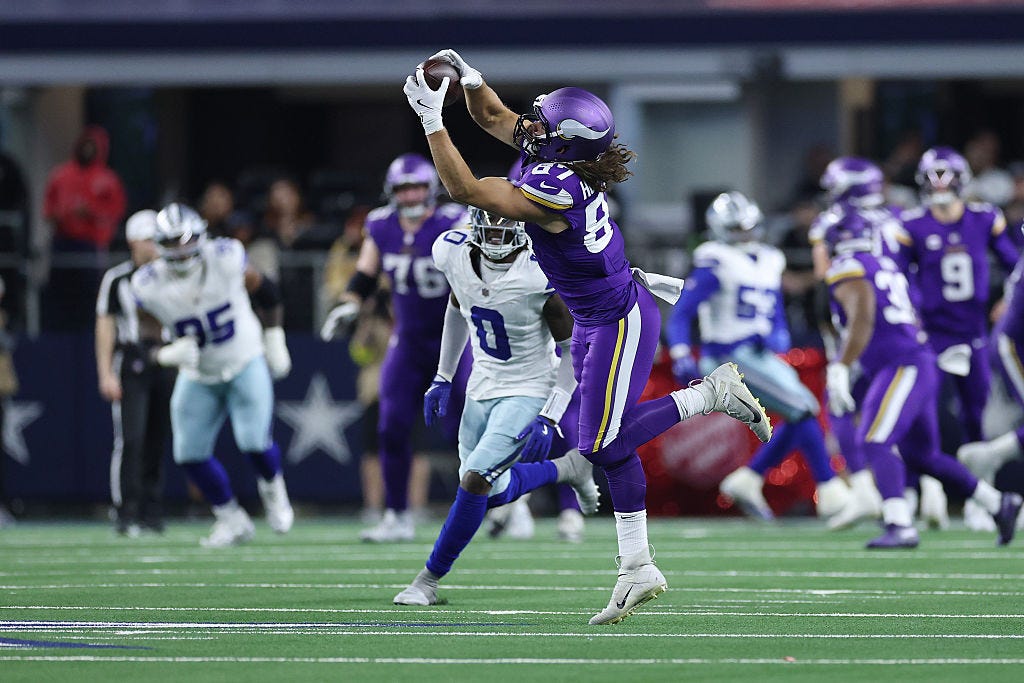
If we want to entertain the idea of the Vikings releasing Hockenson, I do not believe making Josh Oliver the team’s lead TE would be a good idea. Oliver is an excellent blocker, but is just a guy as a pass catcher.
Hockenson is a strong blocker (2025 may have even been his best season as a blocker, from a tape perspective) and can stretch the defense vertically as a receiver. That ability to get vertical stretch is massively important for the construction of the Vikings’ offense, and to convince me that a player is a suitable replacement for Hockenson, he would also need to provide that.
I don’t think Hockenson is the player he was at his peak, but he’s 85-90% of the player who got 960 yards before suffering a brutal knee injury in 2023. His production in 2025 was significantly hampered by QB and OL play because he was constantly asked to stay in and chip, limiting the routes he could run.
Frankly, none of the TEs available in free agency are as good as Hockenson is right now. Dallas Goedert and David Njoku could provide something close to what Hockenson does, but both are older. Why would you want to move on from Hockenson only to spend that money on an older player?
On the younger side of free agent options, Isaiah Likely is not a strong enough blocker to replace Hockenson, and Chig Okonkwo is another move TE. Cade Otton is a great blocker, but lacks the athleticism to play the role the Vikings would need him to.
Daniel Bellinger would intrigue me as a player with the size to block and the athleticism to be a passing game weapon, but there’s a reason the Giants phased him out for Theo Johnson. Beyond that, no young player has a history as a starting TE.

 | A guest post by
|