

The 2026 NFL Consensus Big Board Grades The Draft
The aggregated opinion of 134 draft analysts might not be what you want to hear, but I have it anyway. Using the ranks of the Consensus Big Board, what can we say about this year's NFL draft classes?

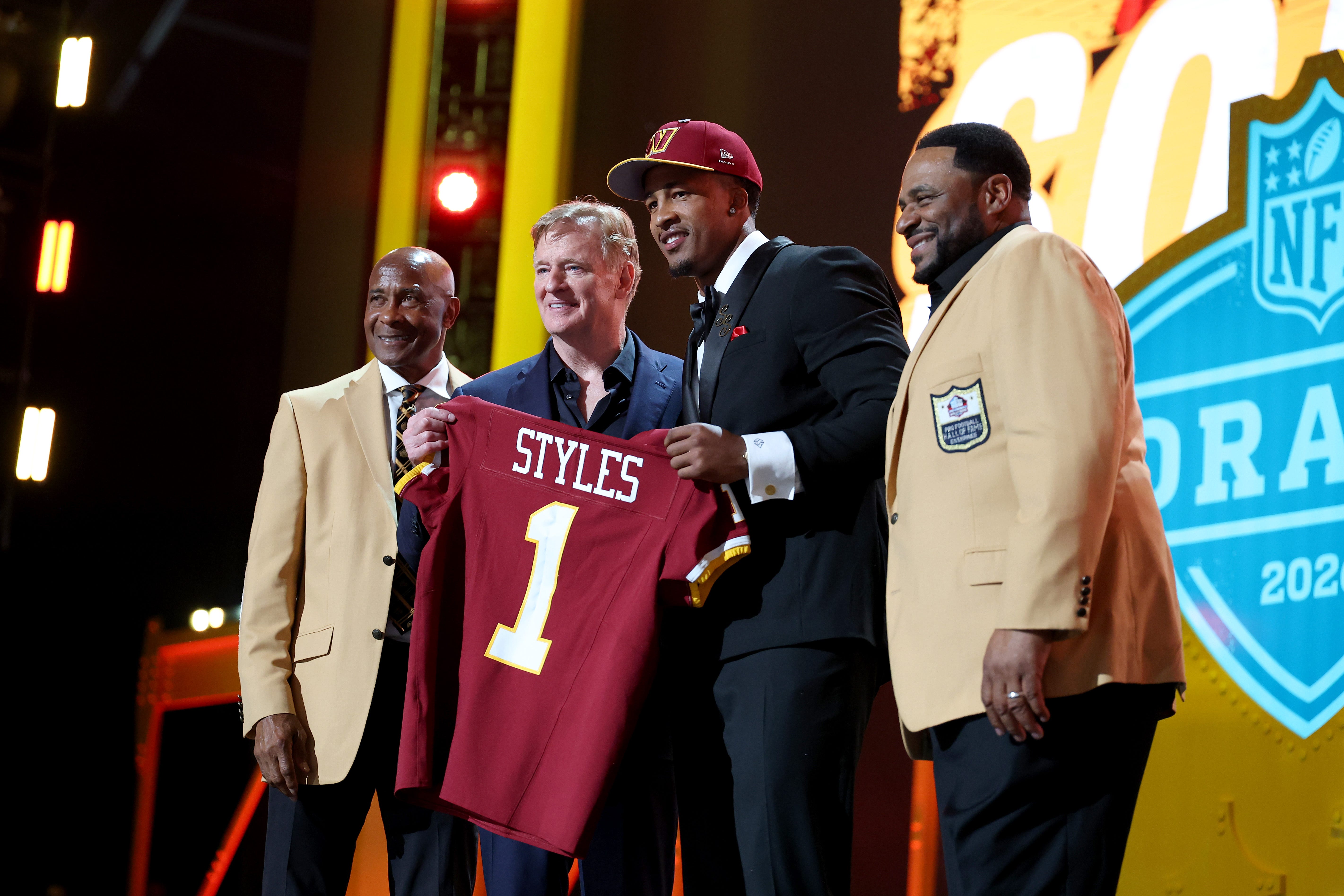
The 2026 NFL Draft is over, which means it’s time to talk about the 2026 NFL Draft.
We have a bunch of data on incoming rookies and we can use it to figure out how teams have done when acquiring those rookies. No approach is perfect of course, but we can at least use our collective wisdom to figure out which teams have best pushed the odds in their favor given what we know.
Table of Contents:
If you want to see the ranks themselves, we’ve got this (free) piece that lists the Top 300 players.
The benefit to a project like the Consensus Big Board is that we can look back on previous classes and see if we were any good at figuring out good draft classes from bad.
The Consensus Big Board project was started with the idea that there is value in bringing together intellectually diverse approaches to evaluating college players and that we’d learn a great deal by casting a wide net when it came to the extraordinary amount of information produced about the NFL draft.
Paul Noonan at Acme Packing Company did an excellent job capturing my thought process in his piece on the subject.
One of the best books ever written on aggregating data in order to make better decisions and predictions is The Wisdom of Crowds by James Suroweicki, and the consensus draft boards are almost textbook examples of smart data aggregation. The board concept itself is built on a simple but effective aggregation method, and it relies on contributors who are independent, who have a fierce diversity of opinion, and who bring specialized, local knowledge to the task.
This year, no player who was drafted by the NFL was unranked by the Consensus Big Board. Two years ago, no player who was drafted was outside of the top 550, a record.
The first player outside of the Top 300 drafted this year was Max Bredson, fullback for Michigan — drafted by the Minnesota Vikings 159th overall and ranked 317th on the Consensus Big Board. This ties the latest we’ve ever seen a player picked that was off the Top 300 board, which was in 2020 when the Patriots selected kicker Justin Rohrwasser 159th overall.
Rorhwasser ranked 796th on the larger board, and the Patriots cut him in camp shortly after a cycle of news focused on his white supremacist tattoo, which had been discovered by Justis Mosqueda of Acme Packing Company during the draft and had been removed by Rohrwasser a few months later.
Last year, Ruben Hyppolite II was drafted 132nd overall by the Chicago Bears. In 2024, it was the Detroit Lions drafting Givanni Manu 126th overall. It might be an NFC North thing at this point.
This year also ties the fewest number of players drafted who were outside the Top 300 — 20, tying the 2024 NFL draft.
This could mean either that NFL teams are becoming more efficient at drafting or that analysts are becoming more efficient at identifying prospects worth drafting.
For what it’s worth, feedback from NFL scouting personnel tells Wide Left that it’s most likely a mix of both. NFL teams have confirmed with Wide Left that they use some version of a Consensus Board in their draft planning. None of the teams that have contacted Wide Left have indicated they use the Consensus Board to alter their opinions of players, but they will use the board in order to get an understanding of where players will be drafted.
At least two teams Wide Left has talked to about the Consensus Big Board have mentioned that they use a combination of a Consensus Board, mock drafts and their own team grades to project where players will go in the NFL draft.
That last element is important, of course, because teams have unique and proprietary information on those players; only they could evaluate the injury concerns for Jermod McCoy or any off-field concerns they discovered in the process of scouting players.
Let’s engage in discourse, then talk about data validation for why it makes sense to at least absorb the Consensus Board grades.
Is the Consensus Board “Groupthink”?
Like with any academic term that has entered the broader social sphere, “groupthink” has lost a lot of its original meaning. Groupthink is not the concept of a large number of people having opinions.
It had primarily been used to describe the notion that people would, through social pressure, be forced into a narrow range of irrational opinions. It is an iterative process, where people with opinions outside of that range are either socially excluded or coerced somehow into changing their opinion.
One element that characterizes “groupthink” is the lack of innovation, independence or creativity in the so-called “group” being coerced into one strain of thought. This was initially used to describe policymaking, with one of the most famous case studies involving the policy process behind the Bay of Pigs invasion.
The issue is not that a group of people made a decision — that is inevitable in any policy outcome. If that were the issue, then groupthink would lose all meaning because any collective activity would be called groupthink. Instead, it was used to describe the internal social process among those making the decision to quash disagreement and data that contradicted their desired outcome.
This often requires value-setting priorities that place group cohesiveness ahead of independent thought, insulation from the group, and a leadership mechanism that isn’t impartial.
None of this applies to the Consensus Board, which does not operate with a leader, does not isolate its contributors and does not punish people with independent thought. In fact, many of the people whose boards contribute to the Consensus Board project are delighted to receive a version of the below message from me when I incorporate their board:
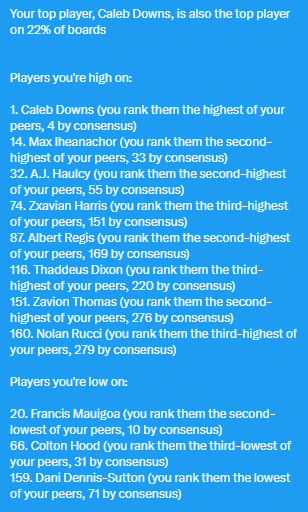
Many draft analysts who receive this message use it to explain who “their guys” are and why they love or don’t love a prospect. This is not a mechanism for getting them to conform to the consensus but to celebrate their perspective on how it differentiates from the consensus.
This independence is important — studies on the idea of “wisdom of the crowds” have found that it works best when the contributing members do not confer on their agreed-upon conclusions. This independence was one of the four essential pillars when the concept was introduced into the public sphere.
Anyone calling this exercise groupthink does not understand the concept of groupthink or the nature of the Consensus Big Board project.
Can the Consensus Board Grade Picks?
In a sense, anything can grade picks. Why not?
But for the purposes of this piece, we want to ask if it’s providing any information worth digesting. The evidence suggests it does. First, we can talk about people who are not affiliated with Wide Left and what they’ve found about using the Board for evaluation purposes.
Timo Riske at PFF performed an analysis of how the Consensus Big Board performed when compared to NFL draft order when predicting player performance, as measured by PFF Wins Above Replacement.
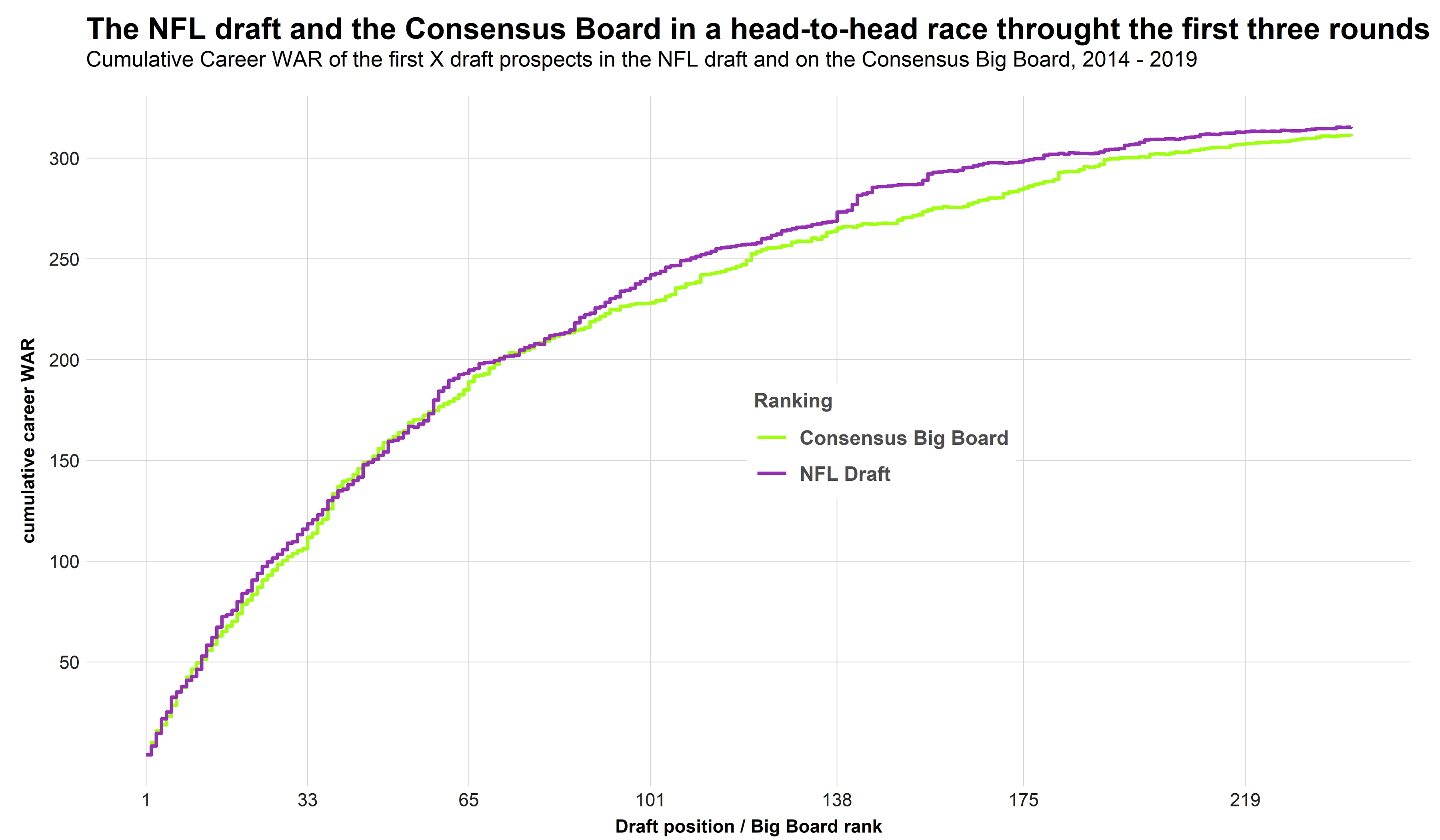
His research found that the Consensus Board was nearly as good as the NFL, despite a few significant disadvantages.
The first disadvantage is pretty obvious: the NFL has control over player outcomes, and the board does not.
The NFL knows how they plan to use players and has an incentive to develop players they draft. Scheme fit is big, and a generic board can’t accommodate all of the synergies of specific teams, coaches and teammates. A team prioritizing outside-zone-style blocking will place athletic guards higher on its board and eliminate slow-footed blockers from consideration.
Even if the Consensus Board nearly perfectly identified talent, one would expect to see higher snap counts for higher draft picks early in their rookie contracts just because of these elements — scheme fit and investment cost. And snap count helps contribute to measures like WAR.
But that’s a small reason. Because PFF’s data relies on WAR, a statistic that depends on a player’s contributions to winning, the measure — and the NFL — overindex on quarterbacks compared to the board. Correcting for that might eliminate the NFL selection process's advantage in WAR-dependent metrics entirely.
Note that this doesn’t necessarily mean that the public is bad at evaluating quarterbacks, it just means that the big boards are not necessarily designed with the intention of maximizing wins, as they are supposed to rank players by talent. The NFL draft, however, has only that one goal: maximizing wins. And that’s why quarterbacks are drafted at the very top.
Another big reason the NFL should have a larger advantage than it seemingly does has to do with the intangibles or invisible elements of a player evaluation. That can be something as minor as locker room leadership or as major as a degenerative medical condition that limits the career lifespan of a prospect.
The evaluators building the boards that end up contributing to the consensus generally don’t know if the stinger a player suffered their sophomore year contributed to a long-term nerve condition or was a minor nothing injury. The NFL does.
Without medical information or other factors like work ethic and practice habits, draft analysts who rely on publicly reported player information — all without access to character profiles, psychological data or player interviews — are at the mercy of players who may not even like playing football.
In addition to all of that, NFL teams have more time and resources — they invest in training their scouting staff, sending them to games across the country and spend more than 40 hours a week per person nailing down their process. Many of the analysts who contribute to the board have a keen eye but are fighting an uphill battle to reach the level of expertise that time and training can provide.
Riske’s approach isn’t the only one that has confirmed the value of the big board in these applications. One may argue with PFF grades – fairly so – but even if we can all agree that they are directionally correct, they aren’t gospel. The thing is, nothing really is and we can all disagree on player performance and value.
One alternative perspective is to see how the NFL itself handles these draft picks. That’s why Jason Fitzgerald’s study into second contract value for draftees is so valuable here. He also found that the Consensus Big Board was about as good as the NFL itself at rank-ordering players.
On our end, we published a deep dive two years ago that looked at every analyst we had data for and at the Consensus Big Board, comparing their rankings and the NFL draft to player outcomes.
Last year, we added 2022 data to that work, and it, unsurprisingly, continued the trend.
What About “Steals” and “Reaches”?
The data analysis performed for the 2024 grading piece tells us that NFL performs a little bit better than the Consensus Big Board when looking at all 700 or so picks in the first three rounds of the NFL draft from 2016 to 2021.
But that advantage comes almost entirely from small gains made on even value picks – things we wouldn’t call steals or reaches, like when the Bengals drafted the number two player overall at number one when they took Joe Burrow. That’s not really a reach, and we can craft our analysis to exclude those cases.
The NFL achieves tons of tiny wins by being a little closer to the correct rank-order value for picks where the board and the NFL don’t really disagree. The math I performed last year came to the conclusion that the NFL won about 52 percent of those even-ranked matchups when it came to assessing player value.
The picks with substantial disagreements were more interesting. Over the past two years, we’ve been adding data to this exercise.
In 2023, the biggest misses by the consensus board don’t actually seem like huge misses; the Consensus Big Board regarded Jalen Carter as the third-best prospect in that draft when his actual draft position of ninth seems closer to his actual value. Dawand Jones (40th) and Kelee Ringo (38th) were pretty big misses. The draft was also correct to value Jack Campbell (ranked 45th, drafted 18th), Darnell Wright (ranked 24th, drafted 10th) and Jahmyr Gibbs (ranked 26th, drafted 12th).
On the other hand, the board seemed more correct on Darnell Washington (ranked 31st, drafted 93rd), Brian Branch (ranked 16th, drafted 45th) and Joey Porter Jr. (ranked 12th, drafted 32nd). It identified the draft overvaluing Anthony Richardson (13th vs 4th), Juice Scruggs (175th vs 62nd) and Brodric Martin (260th vs 96th).
Let’s first take a look at the results in the first round, when the Consensus Big Board either identifies a big steal or a big reach, ignoring those picks where the value is within 15 percent of the pick capital.
80 percent of reaches in the first round fail to meet their pick slot value, which is astounding. In a surprising reciprocity, nearly 20 percent of steals fail to meet their board rank value. So this tells us we should pay much more attention to reaches than to steals.
That makes sense — it takes just one team to misevaluate and reach for a player. But a steal requires multiple teams to come to the same conclusion, making it less likely that someone made a mistake.
But there was a very small sample of steals and a very large sample of reaches. That’s what we would expect; there are very few players to “steal” in the first round because high-ranking players are supposed to be selected there.
What happens in the second and third rounds? Adding in 2023 data made the consensus board worse than the 2016-2022 results, but not enormously so.
It seems as if both the Consensus Big Board and the NFL are “overconfident” when they determine they know a player is substantially more talented than where the other has ranked them. And the NFL’s advantage in tailoring their schemes, isolating team needs and fit, allows them to win at the margins when differences in evaluation don’t really matter.
